What Is a Trust Sale? (And How It Differs From a Probate Sale)
You saw the words on a listing, or an attorney used them in a meeting, and nobody stopped to define them. Here is what a trust sale is, what it is not, and how it compares to the other sales that get confused with it.
By Moe Hannon, Realtor · Ellyn & Main at KW Premiere Properties, Elmhurst IL · Updated September 2026
- A trust sale is a house sold by a trustee because the deed is held in a trust. The trustee signs, not the person who set up the trust and not the beneficiaries.
- It is not a foreclosure. A trustee sale, one word different, is a foreclosure auction under a deed of trust. A trust sale is a normal listing.
- It is usually not a probate sale either. A house in a properly funded trust generally does not go through probate court at all.
- For a buyer, it looks like any other purchase. Financing, inspection and attorney review all work the same way. The seller's paperwork is what differs.
- The delays come from the seller side: a trust that was never funded, co-trustees who cannot both sign, or a certification of trust nobody ordered.
What is a trust sale? In plain English, it is the sale of a house whose deed is held in a trust rather than in a person's name. The trustee sells it, under the powers the trust document gives them, and the proceeds go where the trust says they go. That is the whole definition. The confusion comes from the other things that sound like it, and from the fact that most of what is written about trust sales comes from California, where the process has court steps Illinois does not use.
I sell estate and trust property in Elmhurst, Glen Ellyn and Wheaton, and I represent buyers on these houses too. This is a realtor's explainer, not legal advice. It defines the terms and compares them, and then hands you to the two guides that walk through the process itself: selling a house in a trust after death and, for the case where the person who created the trust is still living, selling a house in an irrevocable trust before death. If the house is in probate rather than a trust, can you sell a house before probate is closed in Illinois covers when a sale can move and when it has to wait.
Trust sale, trustee sale, land trust: three things that are not the same
Three phrases with the word trust in them show up around a DuPage closing, and they mean three different things.
A trust sale is what this page is about. Somebody put their house into a living trust, or an irrevocable trust, and now the trustee is selling it. It is a normal listing with a different signer.
A trustee sale is a foreclosure. In states that use deeds of trust instead of mortgages, the lender's trustee auctions the house when the borrower defaults. If you searched trustee sale and landed here, you are looking for foreclosure information, and this page will not help you.
An Illinois land trust is a way of holding title where a trust company or bank holds the deed and the real owner holds a beneficial interest. It is common in Cook and the collar counties. A sale out of a land trust is also a trust sale in the broad sense, and the Illinois disclosure statute treats it that way. Section 15 of the Residential Real Property Disclosure Act says outright that, for its fiduciary exemption, the word trust includes an Illinois land trust. The paperwork is different from a living trust, so tell your attorney which one you have.
What a trust sale is not: probate
This is the comparison people are usually after, and it matters because the two are often treated as the same thing. Probate is the court process for settling the estate of someone who died. The Illinois Probate Act governs it, and a house in the estate gets sold by the executor or administrator under that Act, with the court involved to the degree the estate requires.
A house that was properly deeded into a trust before death is not part of the probate estate. The trust owns it. The successor trustee sells it without opening a probate case for the house, which is the main reason people set up living trusts in the first place. So a trust sale and a probate sale are two different roads to the same result, run by two different people, under two different sets of rules.
The catch is the word properly. A trust that was signed but never funded, meaning the deed was never recorded in the trust's name, leaves the house in the deceased person's individual name. Then the trust does nothing for that house and probate is back on the table. Pull the recorded deed before you assume which road you are on.
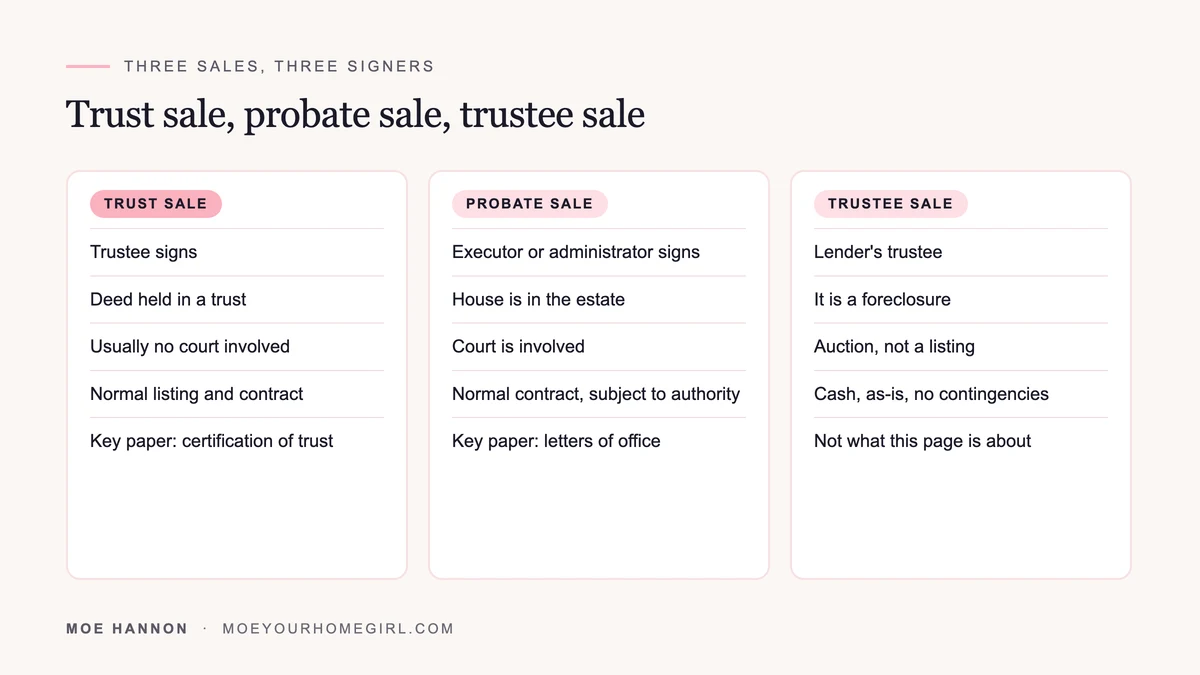
Trust sale versus probate sale versus trustee sale
| Question | Trust sale | Probate sale | Trustee sale (foreclosure) |
|---|---|---|---|
| Who signs for the seller | The trustee, under the trust's powers | The executor or administrator appointed by the court | The lender's trustee |
| Is a court involved | Generally no, if the trust is funded and grants the power to sell | Yes; how closely depends on the type of administration | No sale process in the usual sense; it is an auction |
| Timeline | Similar to an ordinary listing once the paperwork is in hand | Adds the time it takes to open the estate and appoint a representative | Set by the foreclosure process, not the market |
| Seller disclosure report | Fiduciary exemption may apply | Court-ordered and fiduciary exemptions may apply | Different transaction entirely |
| How a buyer's offer is handled | Like any listing: contract, attorney review, inspection, financing | The same, subject to the representative's authority | Cash at auction, as-is, no contingencies |
| Key document the seller produces | Certification of trust | Letters of office from the court | Not applicable |
The middle column is a summary, not advice. Which type of administration an Illinois estate is under, and what that means for the sale, is a question for the estate's attorney.
What a buyer should expect when the listing says trust sale
If you are buying, the words on the listing change less than you think. You write the same contract. You get attorney review, an inspection period and your financing contingency, the same as on any house in DuPage County. Your lender does not treat the loan differently because the seller is a trust. The house is not automatically as-is, and it is not automatically a bargain. It is priced by the same market as the house next door.
What is different is on the seller's side of the table. The signature comes from a trustee, so ask your attorney to confirm the trustee's authority early. The trustee may have never lived in the house, so the seller disclosure may come back with an exemption instead of answers, and you should lean on your inspection instead. And if the trustee is a family member selling a parent's house, expect the human part of the sale to move at a human pace. Patience on a trust sale is usually rewarded.
What really delays a trust sale in Illinois
The sale itself is not slow. What is slow is a missing document. Three come up over and over.
The first is the certification of trust. Under Section 1013 of the Illinois Trust Code, a trustee can give a third party a certification instead of the full trust instrument. It lists who the settlor is, who the acting trustee is, what powers the trustee has, whether the trust is revocable, and how co-trustees must sign. The title company will ask for it. If nobody has ordered it from the attorney, the closing waits.
The second is co-trustees. When the trust names two or three, the document says whether one can act alone or all must sign. An out-of-state co-trustee who has to sign every document in person adds days to each step. Find that out before the listing goes live.
The third is the deed. A trust that was never funded is the most common surprise in these sales, and it is the one that turns a trust sale back into a probate matter. I check the recorded deed at the DuPage County Recorder before I take the listing, so that if there is a problem it shows up in week one and not at the closing table.
Who this page is for, and where to go next
If you just met the phrase, you now have the definition and the comparison. The process itself lives in two other guides on this site, and which one you need depends on a single question: has the person who created the trust died, or not?
If they have, the successor trustee is in charge and the order of operations is in the after-death guide. If they are living and the trust is irrevocable, the trustee sells under the trust's terms and the tax treatment is different; that guide is the before-death one. If you are still trying to figure out whether there even is a trust, or whether the house has to go through probate instead, selling your parents' house after death sorts the three routes. And once the house is on the market, the date-of-death value question comes up next.
One honest note about the internet on this subject. Most of the pages ranking for trust sale are written by California agents, and California trust and probate sales carry court confirmation and overbid steps that do not exist here. If you read that a trust sale requires a court hearing on the offer, that is not Illinois. Ask an Illinois attorney, and ask an agent who has closed these in DuPage County.
A trust sale is a house sold by a trustee because the trust holds the deed. It is not a foreclosure, and if the trust was funded it is not a probate sale either. For a buyer it works like any other purchase. For the trustee, the job is getting the certification of trust, the co-trustee signatures and the recorded deed lined up before the listing goes live. The rest is a normal sale, and that is the part I do as a probate and estate real estate agent in DuPage County.
Sources: 760 ILCS 3/1013, Illinois Trust Code, Certification of trust · 765 ILCS 77/15, Residential Real Property Disclosure Act, Seller exemptions · 755 ILCS 5, Probate Act of 1975. Opened and read on 2026-09-30.
Selling or buying a house held in a trust?
Tell me which side of the table you are on. I will explain what the trust paperwork means for your sale or your offer, and what has to be in hand before the closing date is real.
Straight answers, no hedging.
Is a trust sale the same as a foreclosure?
No. A trust sale is a house sold by a trustee because the deed is held in a trust. A trustee sale is a foreclosure auction under a deed of trust. The names are one word apart and the transactions have nothing in common.
Is a trust sale slower than a normal sale?
Not by itself. Once the trustee has the certification of trust and any co-trustee signatures arranged, it moves like an ordinary listing. Delays come from missing paperwork, an unfunded trust or a co-trustee who is hard to reach, not from the sale type.
Can I use a mortgage to buy a house in a trust sale?
Yes. Your lender underwrites you and the house the same way as on any purchase. The seller being a trust does not change your financing, your inspection period or attorney review.
Do you need probate if the house is in a trust?
Generally not for that house, if the deed was actually recorded in the trust's name. If the trust was never funded, the house remains in the individual's name and may have to go through probate. Check the recorded deed and confirm with an estate attorney.
About the agent
I'm Maureen - but everyone calls me Moe. I have been selling real estate since 2019 and I work out of the Ellyn & Main team at KW Premiere Properties, 100 N Addison Ave in Elmhurst. I hold the Seller Representative Specialist and C2EX designations along with a Luxury Homes certification, and I am a member of KW Luxury. At least $250 of every commission check goes to ShowerUp Chicago and the YMCA of Elmhurst, where I sit on the board. If a house in a trust is about to be sold, or you are trying to buy one, and you want the paperwork explained before it slows you down, call me at 630-890-5430.
This is a realtor's guide, not legal advice.