Selling a House in a Trust After Death: A Trustee's Step-by-Step Guide
You are the successor trustee. The house is yours to sell, nobody handed you instructions, and everyone is waiting on you. Here is the order I run it in.
By Moe Hannon, Realtor · Ellyn & Main at KW Premiere Properties, Elmhurst IL · Updated September 2026
- You probably do not need probate court. If the recorded deed is in the trust's name and the trust names you successor trustee, you can usually sign a listing and a contract without an estate being opened.
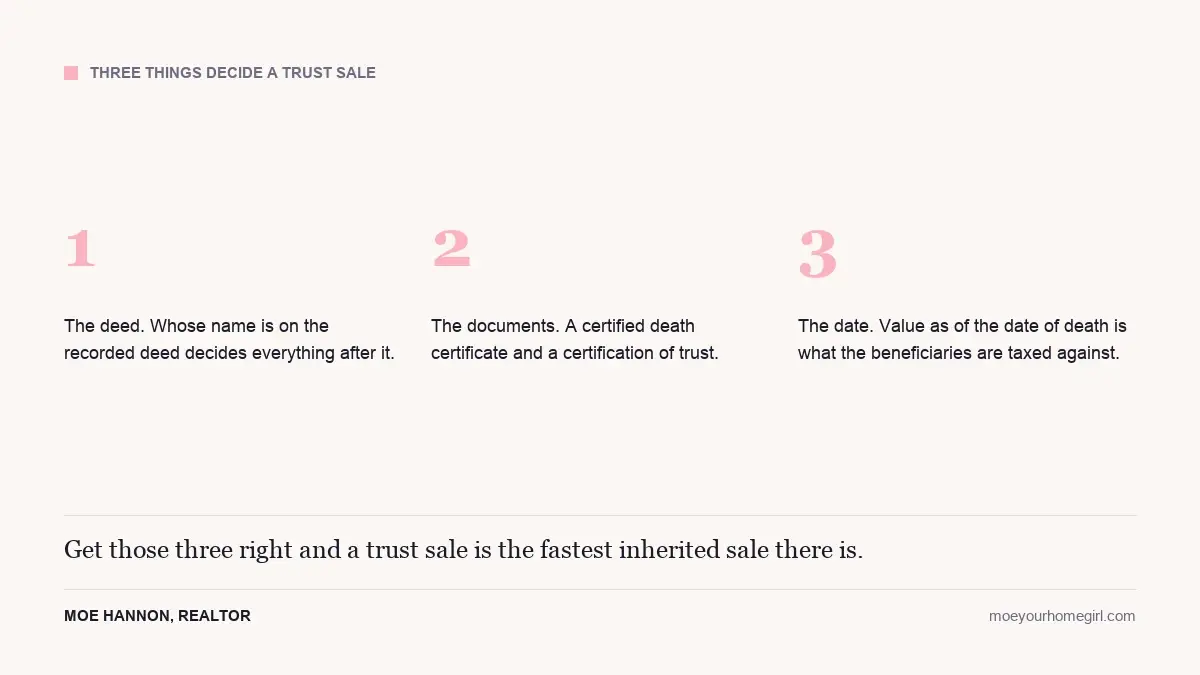
- Two documents get you to a closing table. A certified death certificate and a certification of trust. The second one proves your authority without handing a buyer the whole trust.
- Check the deed before anything else. A trust that was signed but never funded leaves the house in your parent's own name, and that sale goes through probate instead.
- A trustee is exempt from the Illinois seller disclosure report. You still disclose any defect you personally know about.
- The date-of-death value matters more than the list price for what the beneficiaries are taxed on. Get it in writing early, while the house is still furnished.
Selling a house in a trust after death is the calmest version of an inherited sale, and it still goes sideways more often than it should. Not because trusts are complicated. Because nobody tells the successor trustee what order to do things in, and the order is most of the job.
I sell estate property in DuPage County. This is the sequence I run with trustees, written the way I would say it to you at a kitchen table. I am a realtor and not an attorney, so the legal calls belong to the estate's lawyer. The house is mine.
Pull the recorded deed before you read the trust
The most common way one of these sales falls apart is that the trust was signed and the house was never put into it. A trust only controls what it owns. If the deed still reads your mother's personal name, the trust does not control the house, and you are headed for probate whether anyone wanted that or not.
So start at the county recorder, not the filing cabinet. In DuPage County you can search recorded documents by name through the Recorder's office. You are looking at how the last deed reads:
- Jane Doe, as Trustee of the Doe Family Trust dated March 3, 2011. The house is in the trust. Keep going.
- Jane Doe, alone. The trust was never funded as to this house. Call the estate attorney today, not next week.
- Jane Doe and Robert Doe, as joint tenants with right of survivorship. The surviving owner already owns it outright and the trust is not in the picture.
- A recorded transfer on death instrument naming a beneficiary. Different route again, and it also skips court.
Five minutes of looking saves a month of assuming.
Read the powers section of the trust, not the whole trust
You do not need to understand every page. You need three answers: who is named successor trustee, whether that person has accepted the role, and whether the trust gives the trustee power to sell real estate. In a revocable living trust that power is nearly always there, usually under a heading like "Powers of Trustee."
One more thing to find: if there are co-trustees, does the document require both to sign, or can either act alone? Title companies check that. Discovering it at the closing table is a bad afternoon.
Ask for a certification of trust the same day you order death certificates
This is the document almost nobody outside the business knows about, and it is the one that keeps a trust sale private and on schedule. Illinois law lets a trustee hand a third party a certification of trust instead of the entire trust instrument. Under the Illinois Trust Code it states that the trust exists and when it was signed, who the settlor was, who is currently acting as trustee, what powers that trustee holds, whether the trust is revocable, whether co-trustees have to act together, the trust's taxpayer identification number, and how title is held.
That is everything a title company needs and none of what a buyer has no business reading. Ask the attorney for it up front, not the week of closing.
While you are at it, order more certified death certificates than you think you need. Title wants one. So does the lender if there is a mortgage payoff, and so do the utilities, the insurance carrier, and usually a bank or two. Five is a reasonable number.
Secure and insure the house in the first two weeks
This is where families lose real money, and it has nothing to do with the sale price. Most homeowner policies limit or suspend coverage once a house has been sitting empty, and the definition of empty is usually shorter than you would guess. If a pipe lets go in February in an unoccupied house and the carrier was never told, that is a conversation you do not want to have.
Call the insurance carrier, say the owner has died and the house is vacant, ask what they need, and get the answer in writing. Then change the locks, keep the heat on, stop or forward the mail, keep the lawn cut so the house does not advertise that nobody is home, and have someone walk through it every week.
Get the value as of the date of death in writing, before the house is emptied
Two different numbers matter here and people mix them up constantly. One is what the house will sell for today. The other is what it was worth the day your parent died, and that second number is what the beneficiaries are taxed against, because the IRS generally treats the basis of inherited property as its fair market value at the date of the owner's death (IRS Publication 551).
A written opinion of value built from comparable sales as of that date is what the accountant and the beneficiaries work from. It is far easier to produce while the house still has furniture in it than six months later from phone photos. I write these for trustees as a matter of course, before anything gets hauled away. The gap between that figure and the price the house eventually sells for is normal, and how the date-of-death number and the market number differ is worth reading before you take either one to the family.
Clear the house in an order that does not start a family fight
Nobody wants to be the sibling who threw something away. So give the process a shape instead of leaving it to whoever shows up first.
Keepsakes first, with a written list and a real date on the calendar. Everyone gets the same window. After that date the rest goes to an estate sale or an auction company, then donation, then haul-away. Send one update to every beneficiary at the same time so nobody learns something secondhand. A trustee who over-communicates almost never gets accused of anything.
Fix only the things a buyer pays you back for
Estate property does not need to be perfect. It needs to be safe, clean and working. Roof, water intrusion, furnace, electrical panel, anything that will stop an inspection cold: those are worth trust money. A new kitchen in a house that has not been touched since 1994 is not. Buyers price a dated house as a dated house, then pay a premium for a dated house that is obviously dry and sound.
Paint, carpet cleaning, yard work and light bulbs return more than they cost nearly every time. Almost nothing else does.
Know exactly what you owe in disclosures, and what you do not
Illinois exempts a fiduciary from the residential seller disclosure report. The Residential Real Property Disclosure Act is specific about it: transfers by a fiduciary in the course of the administration of a decedent's estate, guardianship, conservatorship or trust are exempt, and the word trust there includes an Illinois land trust.
That exemption exists for a fair reason. You never lived in the house and you genuinely do not know whether the basement takes water in a hard rain.
It is not a license to stay quiet about something you do know. If you know about a problem, put it in writing anyway. And the exemption does not touch the separate federal lead-based paint disclosure for homes built before 1978, which still applies.
Know when the trust route turns back into probate
Three things put you in front of a judge anyway: the house was never deeded into the trust, no named successor trustee is alive and willing to serve, or the trust does not give the trustee power to sell. In DuPage County that estate is opened at the courthouse in Wheaton, which is also where most of the estate property I list ends up being filed, so selling a house in Wheaton and settling one are frequently the same conversation.
Probate is slower and it is public. It does not have to stop work on the house. Value it, clear it and prep it while the court does its part, so you can list the week the letters of office are issued rather than starting from zero. That sequencing is most of what I do as a probate and estate real estate agent in DuPage County.
Here is the whole fork in one place:
| How the house is titled | Who can sign the contract | Probate court? |
|---|---|---|
| Deed is in the name of the trust | The successor trustee, using a certification of trust | No |
| Transfer on death instrument recorded before the owner died | The named beneficiary, once a notice of death affidavit is recorded | No |
| Joint tenancy with right of survivorship | The surviving owner, alone | No |
| Deed still in the deceased owner's name only | The executor or administrator, after the court issues letters of office | Yes, and DuPage estates are filed in Wheaton |
If the deed turns out to be in your parent's name alone, the piece you want next is the one on selling your parents' house after they pass away, which walks the probate and transfer-on-death routes the same way this one walks the trust.
Selling a house in a trust after death is mostly a sequencing problem, not a legal one. Deed, powers, certification, insurance, value, clear-out, repairs, list. Do it in that order and the trust does exactly what your parent set it up to do, which was to keep you out of a courtroom during the worst year of your life.
I am a realtor, not an attorney, and this is not legal or tax advice. Whether a particular trust gives you authority, and what a particular estate owes, are questions for the estate's lawyer and accountant. What I can tell you is what the house needs and in what order, because that part I do every month.
Trustee of a house you now have to sell?
I do the house end of it in DuPage County. The date-of-death value in writing, the clear-out, the repairs worth doing, the listing, and the closing. One update to every beneficiary at the same time, so nobody is chasing you for news.
Straight answers, no hedging.
Can a successor trustee sell a house in Illinois without going through probate?
Usually yes, and that is generally the whole point of the trust. If the recorded deed is in the trust's name and the trust gives the trustee power to sell, the successor trustee signs the listing and the contract without an estate being opened. The two things that stop it are a house that was never deeded into the trust and a trust that does not grant that power. Your estate attorney confirms both straight from the document.
What paperwork does the title company ask for on a trust sale?
In practice: a certified copy of the death certificate, a certification of trust signed by the acting trustee, the trustee's identification, and the recorded deed showing the trust holds title. If there are co-trustees they will check whether both signatures are required. Getting the certification of trust drafted early is the single easiest way to protect a closing date.
Does a trustee have to fill out the Illinois seller disclosure report?
No. Illinois exempts transfers by a fiduciary made in the course of administering a decedent's estate or trust from the Residential Real Property Disclosure Act, and that includes an Illinois land trust. You should still disclose any defect you personally know about, in writing, and the federal lead-based paint disclosure for homes built before 1978 is separate and still applies.
What happens if the house was never put into the trust?
Then the trust does not control it and the sale runs through probate instead, with the executor or administrator signing once the court issues letters of office. It happens more than people expect, often because a house was refinanced after the trust was signed and the lender took it back out of the trust to close the loan. Check the recorded deed first, every time.
About the agent
I'm Maureen - but everyone calls me Moe. I have been selling real estate since 2019 and I work out of the Ellyn & Main team at KW Premiere Properties, 100 N Addison Ave in Elmhurst. I hold the Seller Representative Specialist and C2EX designations along with a Luxury Homes certification, and I am a member of KW Luxury. At least $250 of every commission check goes to ShowerUp Chicago and the YMCA of Elmhurst, where I sit on the board. If you are sorting out a house after a death, call me at 630-890-5430.
This is a realtor's guide, not legal or tax advice.