Can You Sell a House Before Probate Is Closed in Illinois? The Two Clocks, Side by Side
The estate will take months. The house does not have to wait for it. Here is when a house can list, go under contract and close while the probate case is still open, and what has to be true first.
By Moe Hannon, Realtor · Ellyn & Main at KW Premiere Properties, Elmhurst IL · Updated October 2026
- Usually yes. In Illinois the house can be listed and sold while the estate is still open. What you are waiting for is not the end of probate. It is Letters of Office.
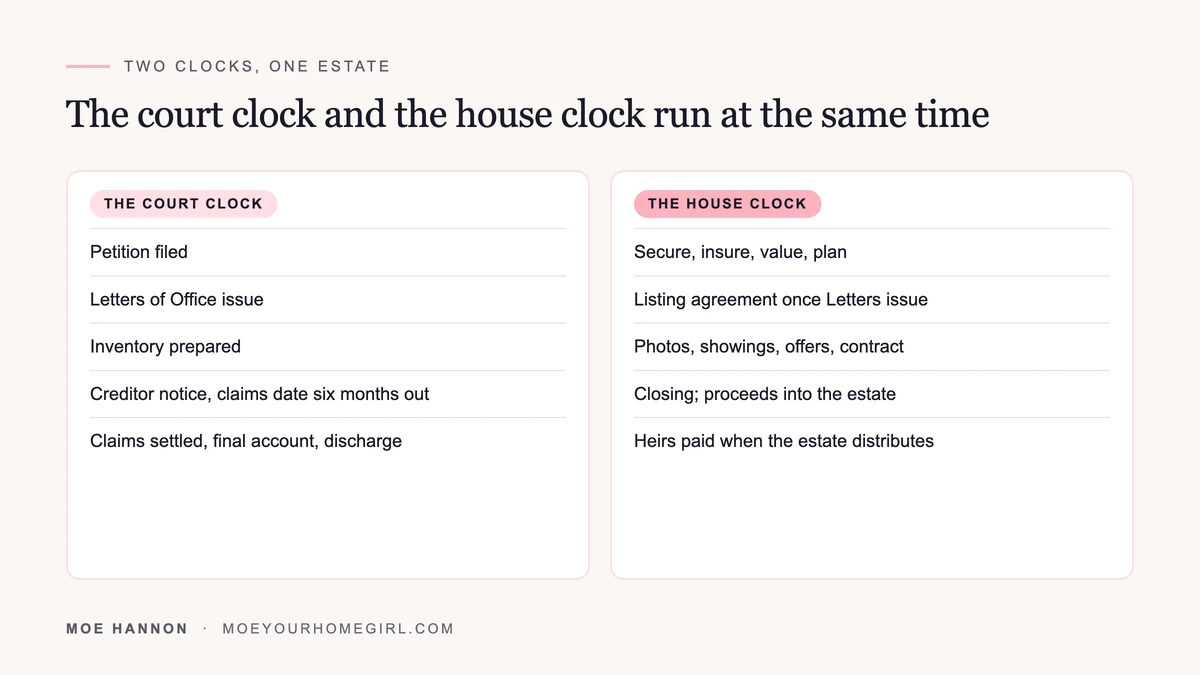
- Two clocks run at once. The court clock (petition, Letters, the creditor claim window, the final account) and the house clock (prep, list, contract, close). They overlap far more than most families expect.
- Independent administration lets the representative sell real estate without a court order. Supervised administration needs leave of court for a sale, unless the will gives the executor a power of sale. Which one you are under is the single biggest timing fact.
- The proceeds often wait even when the closing does not. Money from the sale stays in the estate until claims are handled, so a closing in month three does not mean a check in month three.
- Before Letters issue, you can prepare and you cannot sign. Secure, insure, value and plan, yes. Listing agreement or purchase contract, no.
Can you sell a house before probate is closed in Illinois? In most estates, yes, and a good deal sooner than the family expects. The mistake I see most often is not selling too early. It is an executor waiting for the whole court process to finish before calling anyone about the house, while the house sits empty through a winter paying insurance and taxes for nobody.
I sell estate property in Elmhurst, Glen Ellyn and Wheaton, which means I spend a lot of time explaining where the court calendar and the house calendar meet. This is a realtor's guide, not legal advice: the estate's attorney decides what your estate can do and when. If you are not yet sure whether the house is in probate at all, or in a trust, or passing by a transfer on death instrument, start with selling your parents' house after death, which sorts the three routes. This guide is probate only.
What you are waiting for is Letters of Office, not the end of the case
Probate opens when a petition is filed in the county where the person lived. For a DuPage County resident that is the 18th Judicial Circuit court, which sits in Wheaton. The court admits the will if there is one and issues Letters of Office: letters testamentary to the executor named in the will, or letters of administration if there is no will. Those Letters are the document everything else waits on.
Until Letters issue, nobody has authority to act for the estate. Nobody can sign a listing agreement, accept an offer or sign a deed, because nobody is yet the estate's representative. The moment Letters issue, that changes. The representative can sign, and the house clock can start, even though the estate itself may stay open for many months after.
So the honest answer is: you cannot sell before Letters, and you usually can sell long before the estate closes. Those are two very different waits.
Independent or supervised: the fork that sets the timeline
Illinois estates are administered one of two ways, and the difference decides whether the court has to bless the sale of the house.
Under independent administration, which Article XXVIII of the Probate Act spells out in Section 28-8, an independent representative may sell the decedent's real estate at public or private sale without a court order. The section has two limits: the will can restrict these powers, and real estate specifically left to a named person in the will cannot be sold without that person's written consent. In practice, that means an independent representative with Letters in hand can list the house, take an offer and close it on an ordinary real estate timeline.
Under supervised administration, Section 20-4 requires leave of court before a representative sells or mortgages real estate, on whatever terms the court directs, unless the will gives the executor a power of sale (Section 20-15). That adds a petition, a hearing and the court's calendar to the house clock. Which administration you are under is the first thing to ask the estate's attorney, because every date below moves with the answer.
The two clocks, side by side
| Stage | The court clock | The house clock | Who signs for the estate |
|---|---|---|---|
| After the death | Attorney engaged, petition prepared | House secured, insurance kept in force, utilities on, nothing removed | Nobody yet |
| Petition to Letters (varies with the court calendar) | Petition filed, will admitted, Letters of Office issue | Walk-through, date-of-death value, written list-price opinion, prep plan | Nobody until Letters issue |
| Letters plus 60 days | Supervised: verified inventory filed with the court (Section 14-1). Independent: nothing filed with the court; a copy of the inventory goes to interested persons at least 30 days before the final report (Section 28-6) | Listing agreement signed, photos, house on the market | The representative |
| Letters onward | Notice to creditors published three weeks running; claims date set at least six months from first publication (Section 18-3) | Showings, offers, contract, attorney review, inspection | The representative, on the contract |
| Contract to closing | Independent: no court order needed (Section 28-8). Supervised: leave of court first (Section 20-4), unless the will gives a power of sale (Section 20-15) | Closing; representative's deed; proceeds into the estate account | The representative, on the deed |
| Claims date and after | Claims paid, disallowed or barred; accounting prepared | House already sold; sale proceeds held in the estate | The representative |
| Closing the estate | Final account, distribution, discharge | Heirs receive their share of the proceeds | The representative, then the court |
The statutory figures in this table (60 days, three weeks, six months) are cited to the Probate Act below. The rest is the ordinary shape of these estates, not a promise about yours. The estate's attorney owns the court column.
What you can do before Letters issue, and what you cannot
The weeks between the death and the Letters are not dead time for the house. They are prep time, and families who use them list weeks earlier than families who wait.
You can secure the house, keep the insurance in force and tell the insurer it is unoccupied, and keep the heat on. You can walk the house with an agent and get a written opinion of what it would list for. You can order the date-of-death value, which the estate needs anyway and which answers a different question than the list price; the two numbers are compared in date-of-death value versus what the house will sell for. You can pull the recorded deed, the mortgage payoff and the tax bill so nothing surprises the title company later.
What you cannot do is sign. No listing agreement, no contract, no deed. And nothing of value should leave the house before the estate accounts for it: Section 14-1 requires a supervised representative to file a verified inventory with the court within 60 days of the Letters; in an independent estate the inventory goes to the interested persons instead of the court (Section 28-6). Either way, a house emptied by relatives before that inventory is a problem for the representative, not for the relatives. If the house turns out to be held in a trust rather than the estate, the order of operations is different and lives in selling a house in a trust after death.
Why the money waits even when the closing does not
This is the part that surprises heirs. The house can close in month three, and the check can still be months away.
When the representative sells the house, the proceeds go into the estate, not to the heirs. The estate has to deal with creditors first. Section 18-3 has the representative publish notice to creditors once a week for three weeks and mail it to known creditors, and the date by which claims must be filed is set at least six months from the first publication. Until that date passes and the claims that came in are paid or disallowed, the representative generally holds the money. Section 18-12 puts an outer limit on all of it: claims that could have been barred are barred two years after the death whether or not Letters were ever issued.
So the house clock and the money clock are different clocks too. Selling early does not get the heirs paid early. It stops the bleeding on an empty house and turns an asset that costs money every month into cash sitting safely in the estate while the claims period runs.
When closing before the estate closes is the better call
Not every estate should rush the house. If the will leaves the house to a named person, that person's written consent comes first. If the heirs disagree about selling at all, the attorney may want that settled before a sign goes in the yard. And in a supervised estate, unless the will gives the executor a power of sale, the court's calendar is the calendar.
But in the ordinary independent estate, the case for selling while the estate is open is simple arithmetic. An empty house costs insurance at vacant-property rates, utilities, property taxes, lawn and snow, and the slow damage of nobody living in it. A DuPage winter is hard on an empty house. Every month the estate waits for no legal reason comes out of what the heirs eventually receive, and the spring market does not wait for a claims date.
That is the conversation I have with executors as a probate real estate agent in DuPage County: where the case stands, what the house side can do this month, and how to line the two clocks up so the house is sold and the proceeds are sitting safely in the estate by the time the attorney is ready to close it.
One honest note. A lot of what you will read on this question says the house cannot be sold until probate is over. That is not how Illinois independent administration works, and believing it costs an empty house a season of insurance, taxes and weather. Ask the estate's attorney two questions: which administration are we under, and when do Letters issue. Those two answers set your calendar.
Can you sell a house before probate is closed in Illinois? In an independent estate, once Letters of Office issue, yes: list it, contract it and close it on a normal timeline while the court side runs its claims period in parallel. The money waits in the estate until the claims date passes. Before Letters, prepare everything and sign nothing. If you are the representative and the house is sitting empty while everyone waits for the case to end, the house clock can almost certainly start sooner than you think, and I am happy to walk through where it stands.
Sources: 755 ILCS 5/28-8, Probate Act of 1975, Administrative powers of an independent representative · 755 ILCS 5/20-4, Sale or mortgage of decedent's real estate · 755 ILCS 5/18-3, Notice to creditors, publication · 755 ILCS 5/18-12, Limitations on payment of claims · 755 ILCS 5/14-1, Inventory · 755 ILCS 5/28-6, Service of inventory · 755 ILCS 5/20-15, Sale of real estate under power in will · DuPage Courts, 18th Judicial Circuit Court, Wheaton. Opened and read on 2026-10-07.
Settling an estate with a house in DuPage County?
Tell me where the case stands. I will tell you what the house side can do this month, what has to wait for Letters, and how the two calendars line up.
Straight answers, no hedging.
Can I list the house before Letters of Office issue?
No. Until Letters issue nobody has authority to sign for the estate, so there is no one to sign a listing agreement. You can prepare: secure and insure the house, get a written opinion of value and plan the work. The listing agreement waits for the Letters.
Does the court have to approve the sale of the house?
It depends on the type of administration. Under independent administration the representative may sell real estate without a court order, unless the will restricts that power; if the will leaves that property to a specific person, that person must consent in writing. Under supervised administration the representative needs leave of court before selling, unless the will gives the executor a power of sale. The estate's attorney confirms which applies.
Can the sale close before the creditor claim period ends?
In an independent estate, generally yes. The closing is not tied to the claims date. The mortgage and closing costs are paid at the table, the rest goes into the estate account, and the heirs' share is held there while the claims period runs, which is what protects them if a claim comes in.
When do the heirs get the proceeds from the house?
After the claims date has passed, valid claims are paid and the estate is ready to account and distribute. That is usually well after the closing. The representative distributes once claims are resolved, on the attorney's advice; the sale date does not set it.
About the agent
I'm Maureen - but everyone calls me Moe. I have been selling real estate since 2019 and I work out of the Ellyn & Main team at KW Premiere Properties, 100 N Addison Ave in Elmhurst. I hold the Seller Representative Specialist and C2EX designations along with a Luxury Homes certification, and I am a member of KW Luxury. At least $250 of every commission check goes to ShowerUp Chicago and the YMCA of Elmhurst, where I sit on the board. If you are settling an estate and the house is sitting empty while everyone waits for the court, call me at 630-890-5430.
This is a realtor's guide, not legal advice.