Selling a House in an Irrevocable Trust Before Death: What Changes While the Grantor Is Living
Most of what you will find online assumes the person who set up the trust has died. This is the other case: the parent is alive, the house is in an irrevocable trust, and somebody has to sell it.
By Moe Hannon, Realtor · Ellyn & Main at KW Premiere Properties, Elmhurst IL · Updated September 2026

- The trust document decides, not the grantor. The trustee sells under the powers written in it; the parent who created it usually cannot change them.
- Selling before death usually means no step-up in basis. That is the tax fork most pages bury. Ask a CPA before the house goes on the market.
- A certification of trust is what the title company wants. It proves who can sign without handing the whole trust to a buyer.
- A power of attorney is usually the wrong tool. If the deed is in the trust's name, the trustee signs, not the agent under the POA.
- The house may not be empty. Showings, belongings and a parent who does not want to move are the real work.
Selling a house in an irrevocable trust before death is a different job from selling one after. Almost every article on the subject answers the question a successor trustee asks once a parent has died. The trustee I hear from in this situation has a parent who is alive, often in assisted living or memory care, a house that is sitting empty or still half full, and a trust that says it cannot be changed. The question is not whether the house can be sold. It usually can. The question is who signs, what it costs in tax, and how it gets done without a family fight.
I am a listing agent, not an attorney or a CPA. What follows is the part that is mine: the order things happen in for a trustee selling a house in Elmhurst, Glen Ellyn or Wheaton while the person who created the trust is still living. For the after-death version of this process, read selling a house in a trust after death instead. The two do not swap.
Start with the fork: has the grantor died, or not?
The whole process turns on that one question. If the person who created the trust has died, the successor trustee is in charge and the tax answer is usually kinder. That is the other guide.
If the grantor is alive and the trust is irrevocable, the picture is different in three ways. First, the grantor typically gave up the power to amend the trust or pull the house back out of it when they signed it. Second, the trustee named in the document, who may or may not be the grantor, is the one with authority over the house. Third, the tax treatment of the sale depends on how the trust was drafted, and that is a CPA question I will not guess at for you.
The version I see most often in DuPage County is a trust set up years ago for long-term care planning. Now the parent has moved into care and the house is a cost with nobody living in it. Selling is sensible. It just has to be done in the trust's name and under the trust's rules.
Read the powers section before you call anyone
Every trust has a section that lists what the trustee may do. You are looking for the power to sell real estate, and for anything that limits it: beneficiary consent, a right for the grantor to keep living in the house, a rule that proceeds stay inside the trust. You want to know about those clauses before a buyer does.
If the trust names co-trustees, find out whether all of them have to sign or whether one can act alone. That single detail decides how many signatures a contract needs and how long every step takes when one trustee lives out of state. If the trust says nothing clear on any of this, that is your first call to the estate attorney who drafted it.
Also pull the recorded deed. A trust that was signed but never funded leaves the house in the parent's own name, and then the trust is not the seller at all.
A power of attorney is usually the wrong tool here
This is the confusion I run into most. An adult child holds a power of attorney for a parent and assumes it lets them sell the house. If the deed is in the trust's name, it does not. The agent under a POA acts for the parent as an individual. The trustee acts for the trust, and the trustee signs the listing agreement, the contract and the deed.
If the same person holds the POA and is also the trustee, the sale still runs through the trustee role. Sign as trustee on every document, or the title company sends the paperwork back.
Before death versus after death: what changes
| Question | Grantor is living, trust is irrevocable | Grantor has died |
|---|---|---|
| Who has authority to sell | The trustee named in the trust, under its powers section | The successor trustee, once the death is documented |
| Can the terms be changed | Generally no, that is what irrevocable means; ask the attorney about any exceptions | No, the trust is now fixed |
| Basis for capital gains | Usually the original cost basis carries over; no step-up. Confirm with a CPA | Usually stepped up to the value at the date of death |
| Who may still live in the house | Possibly the grantor, if the trust reserves that right | Nobody with a legal right unless the trust says so |
| What the title company asks for | A certification of trust and the trustee's identification | The same, plus a death certificate |
| Seller disclosure report | The fiduciary exemption may apply; the buyer still asks what you know | The same exemption, same buyer questions |
| Where the proceeds go | Into the trust, then wherever the trust directs | To the beneficiaries per the trust |
Every row in that table is a question for your estate attorney or CPA before it is a question for me. My job is to know which questions to send you to them with, and to keep the sale from getting ahead of the answers.
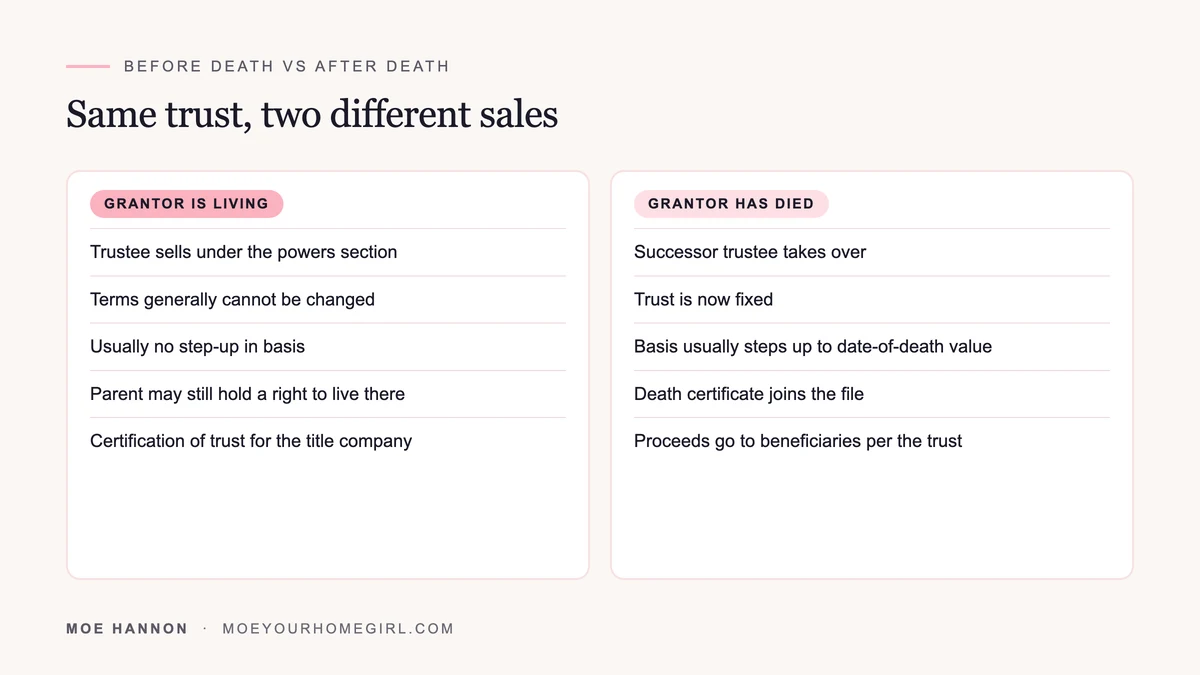
The tax fork: selling before death usually means no step-up
When a house is inherited after a death, the IRS generally lets the new owner use the fair market value at the date of death as the basis for figuring gain, which is what people mean by a step-up. IRS Publication 551 lays out that inherited-property rule. A house sold out of an irrevocable trust while the grantor is alive usually does not get that treatment. The gain is measured from the original basis, which for a parent who bought in Elmhurst decades ago can be a large number.
Whether the trust pays that tax, a beneficiary does, or the trust was drafted so the tax stays with the parent, depends on the document. Before I put a sign in the yard, I want you to have had one conversation with a CPA who has read it. Sometimes that changes the timing. Sometimes it changes nothing. Either way you decide with the number in front of you.
What the title company and the buyer's lender will ask for
You do not have to hand the whole trust to a buyer. Under Section 1013 of the Illinois Trust Code, the trustee can furnish a certification of trust instead of the instrument itself. It states that the trust exists, who the settlor is, who the acting trustee is, what powers the trustee has, whether the trust is revocable or irrevocable, how co-trustees must sign, the trust's taxpayer identification number and how title is held. That one document keeps a closing on schedule. Ask the attorney for it before the house is listed.
The title company will also want the recorded deed showing the trust as owner, the trustee's identification and, with co-trustees, proof of who can sign. The buyer's lender cares little about the trust as long as the seller side is clean. I collect this file up front so nothing is missing at underwriting.
Disclosures when the trustee never lived there
Illinois asks most sellers to complete a Residential Real Property Disclosure Report. Section 15 of that Act exempts transfers by a fiduciary administering a trust, including an Illinois land trust. So a trustee who never lived in the house may not have to deliver the report. Whether that applies to your sale is for the attorney to confirm.
Two things are true even when it applies. Buyers still ask questions, and a trustee who knows about a wet basement should answer honestly. And a house that has sat empty needs attention: the water heater, the sump pump, the furnace that has not run in months. I walk it before the first showing and tell you what an inspector will find.
The house may not be empty, and the parent may not agree
This is the part no legal page covers because it is not a legal problem. In many of these sales the parent is alive, sometimes still in the house, and does not want it sold. Sometimes a co-trustee sibling feels the same way. The trust may give the trustee the authority to sell anyway. Using it without a conversation is how families stop speaking.
My approach is to slow the front end down so the back end can move. Sit with the parent if they are able and explain what the house costs to keep and what the trust requires. Agree with the co-trustees on a list price and a floor before the first showing. If the house is still full of a lifetime of belongings, decide what leaves before photos, and schedule showings around the family. None of that is in the trust document. All of it decides whether the sale goes well.
What I will not do: tell you whether the trust allows the sale, tell you what the capital gains bill will be, or tell you the disclosure exemption applies. Those answers come from your estate attorney and your CPA, and I will hold the listing until you have them. What I will do, as a probate and estate real estate agent in DuPage County, is get the house priced, prepared, shown and closed in the right order once you do, and keep every co-trustee looking at the same numbers the whole way through.
Selling a house in an irrevocable trust before death comes down to four things: confirm the trustee's power to sell and who signs, get the tax answer from a CPA first, have the certification of trust ready for the title company, and handle the family part with more care than the paperwork. If you are still working out which route out of a parent's house you are on, start with selling your parents' house. If the vocabulary is the sticking point, what a trust sale is lays out the terms first.
Sources: 760 ILCS 3/1013, Illinois Trust Code, Certification of trust · 765 ILCS 77/15, Residential Real Property Disclosure Act, Seller exemptions · IRS Publication 551, Basis of Assets. Opened and read on 2026-09-30.
Trustee of a house that has to be sold?
Tell me where the trust stands and who the trustees are. I will lay out the order of the sale and the questions to take to your attorney and CPA before anything goes on the market.
Straight answers, no hedging.
Can a trustee sell a house in an irrevocable trust while the grantor is alive?
Usually yes, if the trust document gives the trustee the power to sell real estate and no clause restricts it. The trustee signs, not the grantor and not an agent under a power of attorney. Have an estate attorney confirm the powers section and any consent requirements before listing.
Do I pay capital gains tax if I sell a house in an irrevocable trust before death?
Often the sale does not get the stepped-up basis that inherited property usually receives, so the gain is measured from the original cost basis. Who owes the tax depends on how the trust was drafted. This is a question for a CPA who has read the trust, and it is worth asking before the house goes on the market.
What does the title company need from a trustee in Illinois?
A certification of trust under Section 1013 of the Illinois Trust Code, the recorded deed showing the trust as owner, the trustee's identification and, if there are co-trustees, proof of who is required to sign. The certification means you do not have to hand the entire trust document to the buyer.
Does a trustee have to give the Illinois seller disclosure report?
Section 15 of the Residential Real Property Disclosure Act exempts transfers by a fiduciary administering a trust, including an Illinois land trust. Whether it applies to your sale is for your attorney to confirm. Buyers will still ask what you know about the house, and you should answer honestly.
About the agent
I'm Maureen - but everyone calls me Moe. I have been selling real estate since 2019 and I work out of the Ellyn & Main team at KW Premiere Properties, 100 N Addison Ave in Elmhurst. I hold the Seller Representative Specialist and C2EX designations along with a Luxury Homes certification, and I am a member of KW Luxury. At least $250 of every commission check goes to ShowerUp Chicago and the YMCA of Elmhurst, where I sit on the board. If you are the trustee of a house that needs to be sold while a parent is still living, and you want the order of it laid out plainly, call me at 630-890-5430.
This is a realtor's guide, not legal advice.