Why Does Square Footage Differ on Listings? Who Measured It and How
You are looking at two listings for the same house, or a listing and a county record, and the square footage does not match. Nobody has to be wrong for that to happen. The numbers come from different people using different rules. Here is who measures what, what each one counts and what to do when the numbers disagree.
By Moe Hannon, Realtor · Ellyn & Main at KW Premiere Properties, Elmhurst IL · Updated October 2026
- Different sources count different space. An appraiser, the county, a listing entry and a builder's plan each follow their own rules, so each can be right by its own rule.
- Finished basements are a common cause. Fannie Mae treats a level as below-grade if any portion of it is below-grade, so a finished walk-out lower level stays out of the above-grade number.
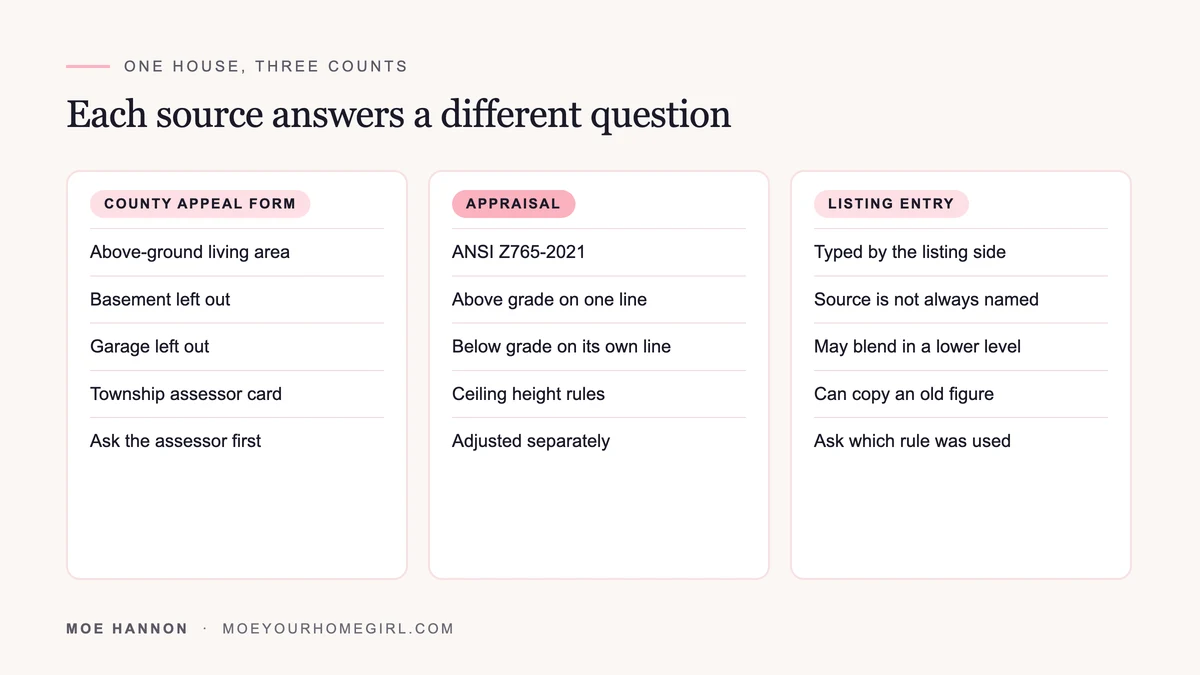
- DuPage County's residential appeal filing instructions define total living area as above-ground square footage only. They exclude finished and unfinished basements and garages.
- The ANSI Z765 standard reports above-grade and below-grade area separately. Fannie Mae requires appraisers to use it, which is why a mortgage appraisal can differ from a listing.
- Ask which standard produced the number, who measured and when. Then ask for a measurement if the answer matters to the price.
Why does square footage differ on listings? Because there is no single square footage for a house. There is the number a rule produces, and the rule changes with who is counting. A county record counts one way, a lender's appraiser another, and the person who typed the listing may have copied a figure from a previous sale. Add a finished basement, an attic bedroom or a heated sunroom and the totals drift further apart.
This post explains where each number comes from so you can read a mismatch instead of guessing. It does not say what size any particular home is. It describes the measurement standards and the records, and your appraiser or a measuring professional confirms the numbers on a specific house.
Why does square footage differ on listings from one source to the next?
Start with the idea that square footage is a count of selected space. Someone decides which space is in and which is out, then measures it. Two honest people using two sets of rules produce two honest numbers.
The biggest choice is whether a space is above grade or below grade. Above-grade space is the part of the home at or above ground level. Below-grade space, like a basement, is treated separately by most formal methods. A listing that says 3,000 square feet might include a finished lower level that an appraiser reports on its own line. Neither number is a mistake. They answer different questions.
The second choice is how the walls and the edges are handled, along with ceiling height, stairs and spaces that connect to the house in an unusual way. The third is the date. A number measured before an addition, or copied from before one, is out of date no matter how carefully it was taken.
What the main rulebooks say
For mortgage appraisals, Fannie Mae's Selling Guide tells appraisers to use the "ANSI Z765-2021" standard when measuring, calculating and reporting above- and below-grade square footage. The same section says Fannie Mae considers a level below-grade if any portion of it is below-grade, so a partially below-grade walk-out area is not included in the above-grade square footage or room count and is reported separately. You can read it in the Selling Guide section on the improvements section of the appraisal report. Home Innovation Research Labs' page on the standard describes ANSI Z765 as a voluntary national standard for single-family homes that covers above-grade and below-grade square footage and does not cover room dimensions.
For property tax, the DuPage County Supervisor of Assessments' residential appeal instructions define total living area as total above-ground square footage and say it does not include unfinished or finished basement square footage or garage square footage. The same page says local township assessors have property record cards on file. The county's glossary describes a property record card as the record of the individual property characteristics used to determine the assessment.
Two things follow. The county's appeal form asks for above-ground area only, while a mortgage appraisal reports above-grade and below-grade area on separate lines, and they are produced by different people for different purposes at different times. And a listing is under no obligation to follow either one.
The who-measures-what table: where each number comes from
| Source | How the number is produced | What it generally counts | What to ask |
|---|---|---|---|
| County appeal form | The county's residential appeal filing instructions define the figure a filer enters | Total living area, meaning above-ground square footage only, with basements and garages excluded | Where is the property record card held, and what does it show for this house? |
| Mortgage appraisal | An appraiser measures and reports under ANSI Z765-2021 | Finished above-grade area on one line and below-grade finished area on another | Which areas were reported above grade, and which were adjusted separately? |
| Listing entry | Typed by the listing side from a prior listing, a record, a plan or a measurement | Whatever the person decided to include, which can include finished lower levels | Which source produced the figure, and does the listing say how it was counted? |
| Builder's plan | Drawn before construction from the design | The designed layout, which may differ from what was built or changed later | Does the plan match the house as it stands today? |
| A fresh measurement | A professional measures the house to a stated standard | Whatever the standard counts, reported with the method named | Which standard, and are below-grade areas shown separately? |
The table does not rank the sources. It shows that each one answers a different question, which is why a mismatch can be a difference in rules and not an error.
Which spaces cause the biggest differences?
Finished lower levels are a common cause of the difference. A basement with finished rooms is a real living space, and a seller or a listing may count it. A formal above-grade count does not. The same house can read noticeably apart depending on which rule is applied, and a finished lower level is often where the numbers split.
Attic conversions and bonus rooms come next. Whether the space counts depends on its finish and its ceiling height, and the ANSI standard has height requirements that a low-slope attic room may not meet. Fannie Mae's guide refers to areas "not conforming to the ANSI ceiling height requirements" as nonstandard finished areas that are reported separately, with an explanation.
Then there are heated sunrooms, enclosed porches and additions. A porch that has been enclosed and heated may be living space to a seller and absent from a record. An addition built with a permit may never have been added to the county card. Where older houses have been added onto, additions and finished lower levels widen the difference.
What to do when two numbers disagree
Do not average them and do not assume the bigger one is the lie. Work through it in order.
First, find out what each number is. Ask which source and which rule produced it, and when. A figure labeled only "square feet" on a listing tells you almost nothing until you know whether it includes a finished basement.
Second, ask whether the difference matters to the decision. If you are comparing homes by price per square foot, the denominator changes with the rule, so two houses can look different when they are not. Compare like with like, above grade to above grade.
Third, if it matters, get a measurement. A seller can hire a professional to measure to a stated standard before listing, and a buyer can ask the appraiser or ask the seller for a measurement. If the county card looks wrong, start with the township assessor, who holds the property record card.
Fourth, put it in writing. If a listing figure matters to your offer, ask the listing side what it was based on and keep the answer. At the high end the stakes are larger, and a luxury and high-end home selling plan in DuPage County should settle the measurements before photographs are taken.
Measurement is one half of the pricing picture and occupancy is the other. Whether a tenant lowers the value of a house covers how a lease changes the buyer pool.
Worth saying plainly. I am a real estate agent, not an appraiser or a surveyor. I can explain why numbers differ and where each one comes from. A measurement you rely on should come from a professional who names the standard, and a question about an assessment goes to the county.
So, why does square footage differ on listings? Each source counts different space under different rules at a different time. Ask which rule and which date, compare like with like, and measure when the number matters. If you are preparing a home for sale, what to repair, refinish or leave alone goes through the rest of the prep.
Sources: Fannie Mae Selling Guide B4-1.3-05, improvements section of the appraisal report · Home Innovation Research Labs, ANSI Z765 square footage standard · DuPage County Supervisor of Assessments, residential appeal filing instructions · DuPage County Supervisor of Assessments, glossary. Opened and read on 2026-10-21.
Getting a listing ready in DuPage County?
Send me the address and the square footage you have seen. I will tell you which sources to compare, what to ask and how to settle the number before the house goes on the market.
Straight answers, no hedging.
Why might the county figure differ from the listing?
They are produced by different people for different purposes. DuPage County's appeal filing instructions define total living area as above-ground square footage and exclude basements and garages. A listing figure is whatever the listing side decided to count, and it may include a finished lower level. The township assessor holds the property record card, so that is where to check what the county has on file.
Does a finished basement count in square footage?
In a formal above-grade count, no. Fannie Mae reports below-grade areas separately, and the ANSI Z765 standard reports above-grade and below-grade area on their own. Many sellers still describe a finished basement as living space, which is why a listing can read larger than an appraisal.
Can I ask the listing agent to re-measure?
You can ask what the figure was based on and whether it has been measured to a stated standard. If it matters to your offer, ask for a measurement or order one yourself through a professional who names the standard they use.
Does the difference change what the house appraises for?
It can, because appraisers report above-grade and below-grade areas on separate lines and adjust for each. A listing figure that blends them is not the number the appraiser uses. Ask your lender how the appraisal will treat any lower-level or converted space.
About the agent
I'm Maureen, but everyone calls me Moe. I have been selling real estate since 2019 and I work out of the Ellyn & Main team at KW Premiere Properties, 100 N Addison Ave in Elmhurst. I hold the Seller Representative Specialist and C2EX designations along with a Luxury Homes certification, and I am a member of KW Luxury. At least $250 of every commission check goes to ShowerUp Chicago and the YMCA of Elmhurst, where I sit on the board. If you are comparing listings or preparing a home for sale and want the square footage sorted out first, call me at 630-890-5430.
This is a realtor's guide, not legal advice.