Preparing a Luxury Home to Sell: What to Repair, Refinish or Leave Alone
Most prep advice is a staging checklist. This is the other half: what a buyer at this level inspects, what is worth doing, what is worth documenting instead, and what to leave exactly as it is.
By Moe Hannon, Realtor · Ellyn & Main at KW Premiere Properties, Elmhurst IL · Updated September 2026

- Buyers at this level often plan their own renovation. Work done to your taste right before you list can be work the next owner undoes.
- Deferred maintenance is what costs you. Roof, mechanicals, drainage and anything that looks neglected will be found, and it colors how a buyer reads the rest of the house.
- An intact original beats a rushed partial update. A dated kitchen in good condition is a buyer's project. A quick half-refresh is a problem they have to undo.
- A complete file can do more than a cosmetic fix. Permits, warranties, service records and system ages answer questions before they turn into negotiation.
- The house gets photographed once. Prep finishes first, then the photos, because those pictures follow the listing for its whole life.
Preparing a luxury home to sell is less about what you add and more about what you fix, what you document and what you leave alone. Most of the advice written on it is a staging list: declutter, add flowers, light the fireplace. That is fine as far as it goes. What it skips is the part that matters at the high end of the market, where the buyer's inspector is thorough, their attorney is engaged, and anything the house has been putting off will come up in writing.
This is how I think about getting a high-end house in Elmhurst, Glen Ellyn or Wheaton ready before it goes on the market, system by system, including the parts I would tell you not to touch.
What does a buyer at this level notice first?
A buyer looking at the top of a market has usually seen a lot of houses, and they tend to read each one in two passes. The first pass is how it feels: light, flow, condition, whether the rooms work for the way they live. The second pass is what they will have to deal with: the roof, the mechanicals, the windows, the drainage and whatever the inspection turns up.
The second pass is where preparation earns its keep. A beautiful house with a tired furnace and a patched roof does not read as beautiful for long, because the buyer's attention moves to what they will have to fix and what else might be hiding. A house that is sound underneath lets the buyer stay in the first pass, which is where you want them.
So the order of work is almost always the same. Anything failing comes first. Anything that looks neglected comes second. Cosmetic changes come a distant third, if at all.
Repair, refinish or leave alone, system by system
| Area | What a high-end buyer notices | Usually worth doing | Often better documented or left alone |
|---|---|---|---|
| Roof | Age, condition, any active leak | Repairing anything leaking or visibly failing | Its age and service history, in writing |
| Windows | Fogged seals, rot, drafts | Fixing failed seals and damaged sashes | A full replacement just before listing |
| Mechanicals | Age of the furnace, air conditioning and water heater | Servicing everything and fixing what is not working | Replacing a working system for its age alone |
| Kitchen | Condition and layout first, finishes second | Repairs, a deep clean, every appliance working | A remodel to your own taste |
| Primary bath | Water damage, grout, ventilation | Fixing leaks, re-caulking, repairing fixtures | A full remodel weeks before listing |
| Floors | Wear patterns, damage, mismatched patches | Refinishing worn hardwood | Replacing sound original flooring |
| Millwork and paint | Chips, scuffs, tired colors | Touch-ups and fresh neutral paint where it is worn | Painting over or replacing good original wood |
| Landscaping | Curb appeal, drainage, overgrowth | Cleanup, pruning, mulch, fixing drainage | Redesigning the whole yard |
| Pool, if there is one | Equipment condition, safety | Servicing the equipment and fixing safety items | Resurfacing purely for looks |
There is no cost column in this table on purpose. What the work costs is a question for the contractors who would do it, and what it returns depends on the house. What I can tell you is which list a buyer at this level is likely to put each item on.
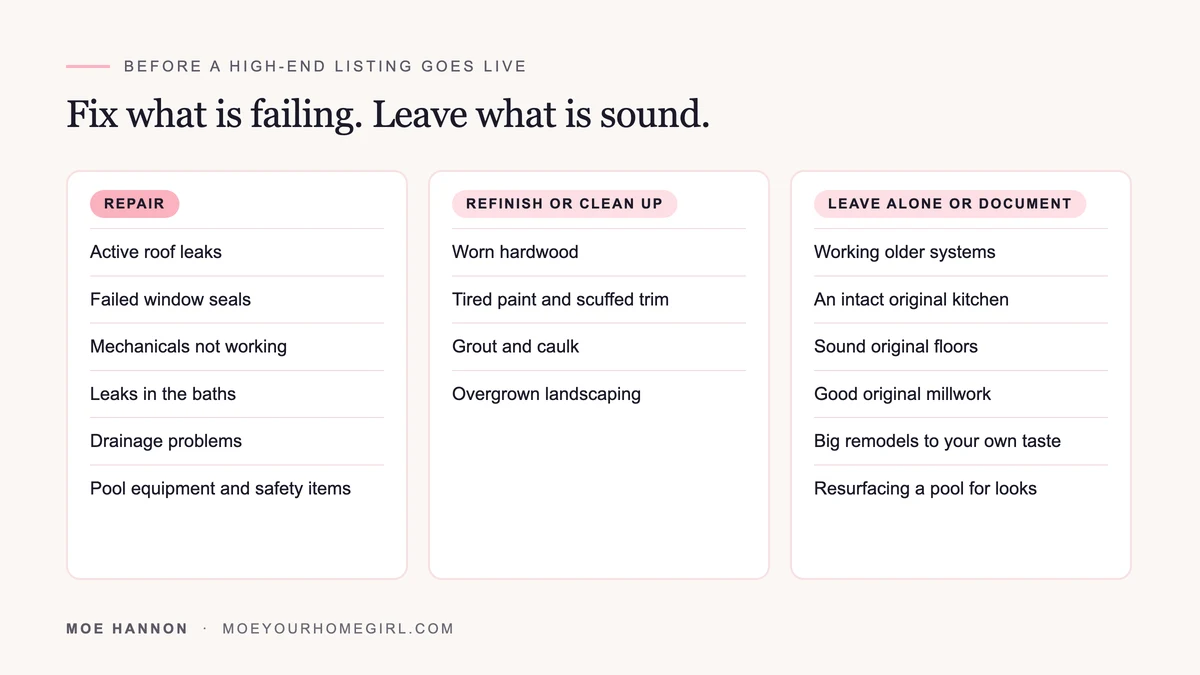
Leave alone is the section nobody writes
This is the part of preparation that runs against instinct. A half-finished or rushed renovation reads worse than an honest original. A kitchen from a couple of decades ago, in good condition, with working appliances and nothing broken, is a buyer's project. They can see what they are getting, and they have probably already pictured what they would do with it.
A quick partial refresh is different. New counters on old cabinets, a trendy backsplash, a fixture swap that does not match the rest of the room. A buyer at this level sees that as something to undo before they can do what they wanted, and they discount for the undoing as well as the doing.
The same logic applies to original details. Solid original millwork, built-ins, hardwood floors and period features in an older DuPage house are often part of what the buyer came for. Painting over good wood or replacing an original staircase to look current is usually a loss, not a gain.
Leaving something alone does not mean ignoring it. It means cleaning it, repairing whatever is broken, and letting it be what it is.
Why does a pre-listing inspection change the negotiation?
At this level I suggest considering an inspection before the house goes on the market. Not to fix everything on the report, but so you know what a buyer's inspector is likely to find before they find it.
Knowing the report in advance changes three things. You can repair the items that would worry a buyer, you can plan around the items you choose not to fix, and you are not learning about a problem for the first time in the middle of attorney review. Most Illinois home sellers also complete a disclosure report under the Residential Real Property Disclosure Act, and that report asks what you know, so talk with your attorney about your inspection results before you fill it out.
For an older house there is one more item. Federal rules require sellers of most housing built before 1978 to give buyers specific information about known lead-based paint before a contract is signed, as the EPA explains. If your house predates that, your attorney will already have it on the list.
The negotiation itself belongs to your attorney and comes later. The inspection is how you walk into it prepared.
Documentation can do more than a cosmetic fix
A buyer's side at this level will ask questions. When was the roof done? How old is the furnace? Was the addition permitted? What is still under warranty? A seller who can answer each one with a piece of paper looks like someone who took care of the house. A seller who says they think it was around ten years ago invites the buyer to assume the worst.
Worth pulling together before you list: permits and final inspections for any additions or major work, warranties that transfer to a new owner, service records for the mechanicals, the age of every major system, any survey you have, and receipts for major improvements. That last one helps you as well as the buyer. IRS Publication 523 explains that improvements are work that adds to the value of your home, prolongs its useful life or adapts it to new uses, and that their cost is added to your basis. That is a conversation for your tax adviser, and it is a much easier one with the receipts in hand.
Photography comes last, and happens once
The order of operations matters more than any single task. Repairs first, then refinishing, then cleaning, then staging, and only then the photographs. A house photographed partway through its preparation carries those pictures for the whole life of the listing, and at this level the photographs are how many buyers decide whether to see the house at all.
That usually means the prep period runs several weeks, and the launch date is set backward from when the house will be ready, not the other way around. Rushing to hit a date with work still going on is one of the more costly shortcuts a seller can take.
I will not tell you to renovate to chase a number. I do not project what a project will return, and I am not a contractor, so I will not price the work. What I will do is walk the house with you and tell you which list each item belongs on. If the honest answer is that the house should go on the market as it is, you will hear that too.
Preparing a luxury home to sell comes down to a short list: fix what is failing, refinish what is tired, document what is sound, leave alone what a buyer will want to change themselves, and photograph the house once it is ready. That is where I start the work as a luxury real estate agent in DuPage County, and more plain-English help for the bigger moves is in the guides.
Sources: 765 ILCS 77, Residential Real Property Disclosure Act · US EPA, Real Estate Disclosures about Potential Lead Hazards · IRS Publication 523, Selling Your Home. Opened and read on 2026-09-23.
Getting a high-end house ready to list?
I will walk the house with you and sort every item into repair, refinish or leave alone, before you spend anything.
Straight answers, no hedging.
Should I get a pre-listing inspection on a high-end house?
It is worth considering. It tells you what a buyer's inspector is likely to find, so you can repair the items that would worry a buyer and plan around the rest before attorney review rather than during it. Talk to your attorney about how the findings relate to your disclosure report.
Should I replace older systems that still work?
Usually not for their age alone. Service them, fix anything that is not working, and document the age and service history. A buyer can plan around an older system with a clean record far more easily than around one with no paperwork at all.
What paperwork should I gather before listing?
Permits and final inspections for additions or major work, warranties that transfer, service records for the mechanicals, the age of each major system, any survey, and receipts for significant improvements. A complete file answers a buyer's questions before they become negotiation points.
When should the listing photos be taken?
After every repair, refinish, cleaning and staging step is finished, and not before. The photographs follow the listing for its whole life, so a house shot partway through its preparation is presented that way to every buyer who finds it online.
About the agent
I'm Maureen - but everyone calls me Moe. I have been selling real estate since 2019 and I work out of the Ellyn & Main team at KW Premiere Properties, 100 N Addison Ave in Elmhurst. I hold the Seller Representative Specialist and C2EX designations along with a Luxury Homes certification, and I am a member of KW Luxury. At least $250 of every commission check goes to ShowerUp Chicago and the YMCA of Elmhurst, where I sit on the board. If you are getting a high-end house ready to sell and want a straight read on what to fix and what to leave, call me at 630-890-5430.
This is a realtor's guide, not legal advice.