Does a Tenant Lower the Value of a House? It Shrinks the Buyer Pool
You own a house with a tenant in it and you are thinking about selling. The first worry is usually price. The real question is who is allowed to buy it, how they can pay, and what the lease does to their timeline. Here is how that works, lease situation by lease situation.
By Moe Hannon, Realtor · Ellyn & Main at KW Premiere Properties, Elmhurst IL · Updated October 2026
- The house itself does not change. What changes is who can buy it. A tenant who stays after closing rules out the buyer who needs to move in.
- Owner-occupant loans come with an occupancy rule. FHA's handbook says at least one borrower must occupy the property within 60 days of signing the security instrument and intend to stay at least a year. Fannie Mae treats a property the borrower does not occupy as an investment property.
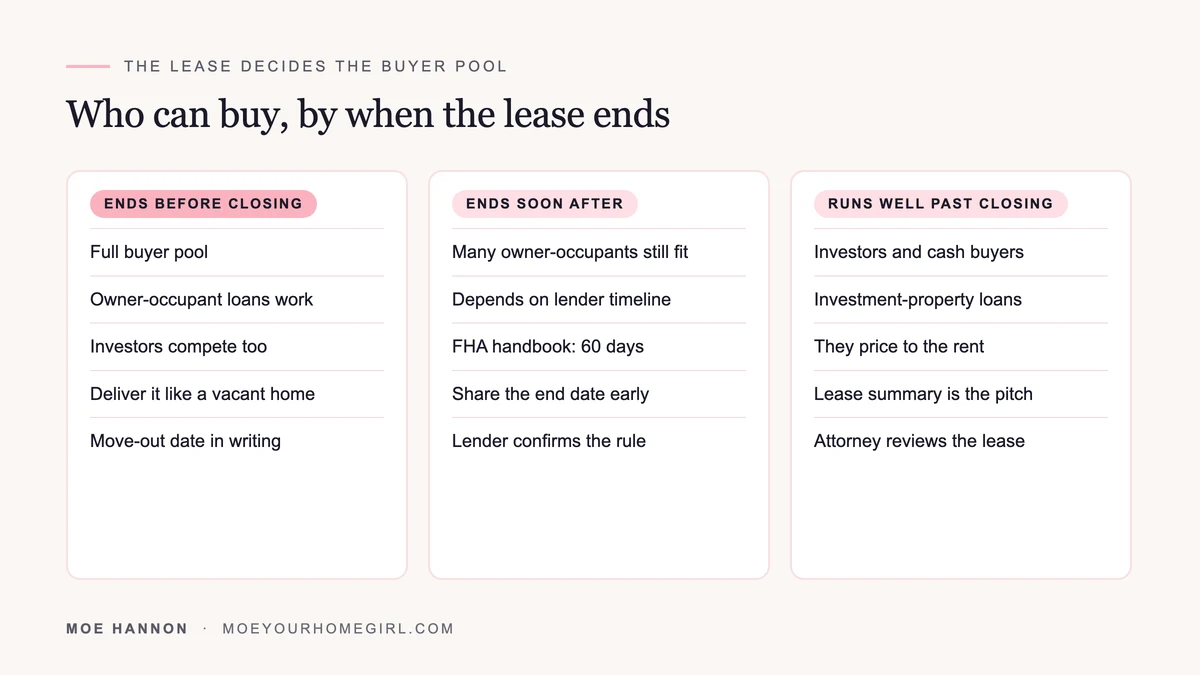
- A lease that ends before closing, or soon after, keeps the full buyer pool open. A lease that runs well past closing leaves investors and cash buyers.
- Research on this finds a temporary effect. One 20-year study of home sales found a short-term price and liquidity penalty while a home was rented and no lasting effect from the rental history itself.
- Plan the listing around the lease, not around the calendar. A one-page lease summary, a showing schedule your tenant has agreed to and a clear move-out date do more than a price cut.
Does a tenant lower the value of a house? Not the way most landlords fear. The structure, the lot and the town are the same with or without a lease. What changes is who can buy it. A buyer who plans to live in the house usually cannot take it with a tenant who is staying, and many buyers plan to live in the house they buy. When that group steps back, the people left are investors and cash buyers, and they price the house to their own return.
This post is about that buyer pool and how it moves with the lease. For the paperwork a tenant-occupied listing needs, read documents needed to sell a tenant-occupied property. This post describes how the rules work and is not legal or lending advice. Your attorney and your lender apply them to your facts.
Does a tenant lower the value of a house, or just narrow who can buy it?
Value and price are different things. Value is what the house is worth as a property. Price is what a particular buyer will pay on a particular day. A tenant does not change the first. A tenant can change the second, because the price follows the buyers who are able to compete.
Picture the same house listed twice. Vacant, it is open to a buyer who wants to move in, a buyer relocating for work, and investors. With a tenant who will remain after closing, the owner-occupant and the relocating buyer mostly cannot make an offer that works, since they need a place to live on closing day. That is fewer offers, and fewer offers is the whole effect. It is a competition problem, not a defect in the house.
It also explains why the same lease can matter a lot on one listing and barely at all on another. If the lease ends before closing, the house is delivered the way a vacant one would be, and the question mostly goes away.
Why can a buyer's primary-home mortgage not coexist with your lease?
Most buyers who plan to live in a home borrow on an owner-occupant basis, and the lenders behind those loans write occupancy into the rules. The FHA handbook (HUD Handbook 4000.1) states the FHA requirement this way: "At least one Borrower must occupy the Property within 60 Days of signing the security instrument and intend to continue occupancy for at least one year." That text comes from the August 2019 edition I opened. HUD updates it, so your lender confirms the current wording.
Fannie Mae's Selling Guide on occupancy types draws the same line from the other side. A principal residence is a property the borrower occupies as their primary residence. An investment property is owned but not occupied by the borrower. A buyer who cannot move in is, in lender terms, buying an investment property, and that loan has its own terms that the lender sets.
So the practical question is the date. If the tenant is gone before the buyer's occupancy deadline, an owner-occupant buyer can still work. If the tenant is there for a year past closing, that buyer cannot. I cannot tell you where a particular lender draws the line for a particular buyer. I can tell you to put the lease end date at the top of the listing summary so the buyer's lender sees it on day one.
The lease-situation table: who can buy and how they can pay
| Lease situation | Who can buy | How they can finance | What the seller can do |
|---|---|---|---|
| Lease ends before closing and the tenant moves out | The full pool, including buyers who plan to live there | Owner-occupant loans and investor loans, as on a vacant home | Put the move-out date in writing and plan a walk-through before closing |
| Lease ends shortly after closing | Most owner-occupant buyers, if the end date falls inside their lender's occupancy timeline | Depends on the lender and the loan. FHA's handbook sets 60 days from signing the security instrument | Share the end date with the listing so buyers can ask their lender early |
| Lease runs well past closing | Investors and cash buyers, mostly | Investment-property financing or cash | Offer the lease and rent history in a one-page summary, since the buyer is buying that income |
| Tenant with no fixed end date | Depends on whether the buyer can end the tenancy in time, which your attorney explains | Lenders ask what the occupancy will be at closing | Ask your attorney whether to end the tenancy properly before listing |
| Vacant at closing | The full pool | Any loan the buyer qualifies for | Prepare and show it like any other listing |
No row is a promise about any one buyer. The table shows how the lease changes the list of buyers who can finish a purchase. Your lender and attorney confirm the details for your situation.
What the research says about the discount, and why it fades
Turnbull and Zahirovic-Herbert studied about 20 years of house sales and published the result in the Journal of Real Estate Finance and Economics. Their abstract opens with the belief that "tenant-occupied houses do not show as well as owner-occupied or even vacant units," and reports "strong transitory renter effects on both value and liquidity." It also says they "do not find persistent legacy effects from prior use as rental property." The University of Memphis repository record carries the same paper.
Read that plainly. While the house is rented, it tends to sell for less and to take longer. Once an owner-occupant buys it, the penalty does not follow the house. The authors also suggest that houses well suited to renting tend to have lower values whether or not they are rented today, which is a statement about the kind of house and not about your tenant.
I would not turn that into a discount percentage for your house, and neither should anyone quoting you one. The study is about patterns across many sales. Your lease, your street and your timing are what set your outcome.
What should you do before you list a house with a tenant in it?
The moves that help most are about timing and information, not about the price on the sign.
First, decide whether the lease should end before you list. If it ends soon anyway, listing after the tenant leaves opens the house to every buyer and makes showings simple. If you cannot wait, list with the lease in place and aim at the buyers who can use it. Either way, have your attorney review how and when a tenancy can end, since that is a legal question and not one I answer.
Second, write a one-page lease summary for buyers and their lenders: the end date, the lease type, what the tenant pays and anything the lease says about access. An investor reads it as the income statement for the property. An owner-occupant buyer reads it as the answer to whether they can finish.
Third, set showings with your tenant in advance and keep to the schedule. Showings go better when the tenant knows the plan, and that part of listing a rental is covered in listing a house with tenants in DuPage County.
Finally, price to the buyers who can actually close. If the lease runs past closing, the people competing are investors, and they price to what the house earns. A list price built on a vacant neighbor's sale will sit. If you own in Elmhurst or Wheaton, that comparison is the first thing to settle before anything goes live.
Tenant-occupied homes also tend to carry older listing data, which is one reason square footage differs between listings and why a fresh measurement matters before pricing.
Worth saying plainly. I am a real estate agent, not an attorney or a lender. Whether a lease survives a sale, and how a tenancy can end, are questions for your attorney. Whether a buyer qualifies on a given loan is a question for their lender. What I can do is lay out the lease situation so each of them can answer quickly.
So, does a tenant lower the value of a house? The house keeps its value and the buyer pool shrinks, and the lease end date decides by how much. Get the date in front of buyers early, write the lease summary, plan showings with your tenant and price to the buyers who can close. Those moves beat waiting and hoping.
The lease also puts a deposit on the table, and what happens to the security deposit when the rental sells covers where it goes at closing.
Sources: HUD Handbook 4000.1, FHA Single Family Housing Policy, owner occupancy requirement · Fannie Mae Selling Guide B2-1.1-01, occupancy types · Turnbull and Zahirovic-Herbert, Journal of Real Estate Finance and Economics, 2012 (abstract) · University of Memphis repository record. Opened and read on 2026-10-21. The FHA wording is from the August 2019 edition of the Handbook.
Selling a house with a tenant in it?
Send me the address and the lease end date. I will tell you which buyers that lease leaves open, what to put in the lease summary and what to ask your attorney before you list.
Straight answers, no hedging.
Does a tenant always lower the sale price?
No. A tenant changes who can buy, and the effect depends on the lease. If the lease ends before closing, the house reaches the full buyer pool and the effect is small. If it runs well past closing, investors and cash buyers are the main buyers, and they price to what the house earns. A 20-year study of home sales found a short-term price and liquidity penalty while a home was rented and no lasting effect from the rental history itself.
Can a buyer using an owner-occupant loan buy a house with a tenant?
Only if the tenant will be gone in time for the buyer to move in under that loan's occupancy rule. FHA's handbook says at least one borrower must occupy within 60 days of signing the security instrument and intend to stay at least a year. A buyer who cannot move in is buying an investment property in Fannie Mae's terms. The buyer's lender confirms the rule for their loan.
What if the lease ends before closing?
Then the house can be delivered the way a vacant one would be, and the full buyer pool is open. Put the move-out date in writing, schedule a walk-through before closing and tell buyers the date up front so their lenders can plan around it.
Should I wait for the lease to end before listing?
It depends on how far off the end date is and what you need from the sale. Waiting opens the house to every buyer. Listing now with the lease in place aims at investors and cash buyers. Talk it through with your attorney and with me before you decide, since timing the listing to the lease is one of the biggest levers you have.
About the agent
I'm Maureen, but everyone calls me Moe. I have been selling real estate since 2019 and I work out of the Ellyn & Main team at KW Premiere Properties, 100 N Addison Ave in Elmhurst. I hold the Seller Representative Specialist and C2EX designations along with a Luxury Homes certification, and I am a member of KW Luxury. At least $250 of every commission check goes to ShowerUp Chicago and the YMCA of Elmhurst, where I sit on the board. If you own a house with a tenant in it and want to know which buyers it will reach, call me at 630-890-5430.
This is a realtor's guide, not legal advice.