How to Tell if a House Is a Teardown: Reading a DuPage Street Before You Write an Offer
You picked the town. Now you are standing on a block where a 1950s ranch sits next to a house that was finished last spring, and you cannot tell which one you are about to pay for. Here is how to read the street before you read the listing.
By Moe Hannon, Realtor · Ellyn & Main at KW Premiere Properties, Elmhurst IL · Updated October 2026
- A teardown is a house whose value sits mostly in the lot. The clearest sign is not the house. It is what has already happened to the houses around it.
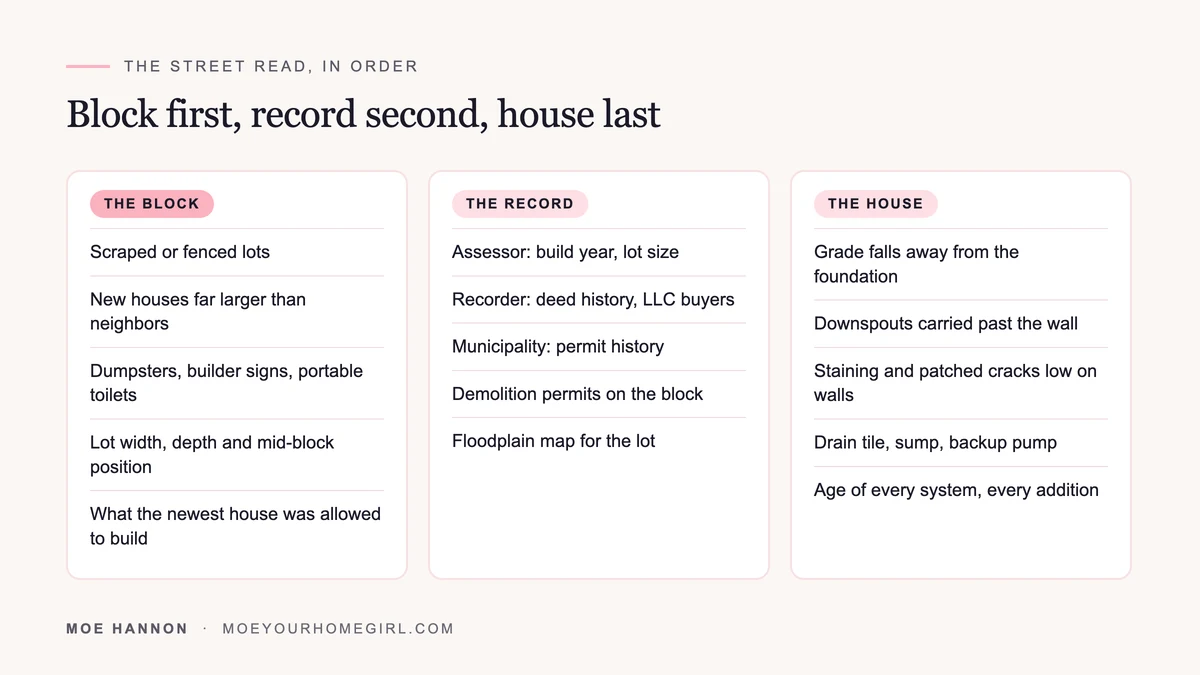
- Read the block first. Scraped lots, new houses two or three times the size of their neighbors, construction fencing and dumpsters tell you where builders are already buying.
- Then read the lot. Width, depth and a mid-block position matter more to a builder than the kitchen ever will.
- Pull the public record. The township assessor's property record shows the build year and lot size, the recorder shows the deed history, and the city permit portal shows what was done with a permit and what was not.
- The basement decides older DuPage houses. Water, grading and drain tile are what separate a keeper from a project.
How to tell if a house is a teardown is a question relocating buyers ask me on the sidewalk, usually while looking at two houses on the same block that could not be more different. One is a 1,200 square foot ranch with the original windows. The other is 4,000 square feet of brick and stone that did not exist three years ago. The ranch is priced like a house. The question is whether anyone else bidding on it sees a house at all.
I show houses on these blocks in Elmhurst, Glen Ellyn and Wheaton, and the read below is the one I do before a client falls for a kitchen. It is a read of housing stock, not a verdict on any one street, and it is not an inspection. It tells you what to ask.
How to tell if a house is a teardown: start with the block
Builders do not buy one house in a neighborhood nobody is rebuilding. They buy where the math has already worked for someone else. So the first thing to look at is not the house you came to see. It is the six or eight houses on either side of it and across the street.
Walk the block and count. A lot scraped to dirt and fenced. A brand-new house visibly larger than everything around it, often taller, often pushed to the edges of its lot. A dumpster in a driveway, a portable toilet on a parkway, a builder's sign on a stake. Two or three of those on one block means a builder can pay more for the dirt there than someone buying to live there will pay for the house standing on it.
Zero of those means that, today, the buyers you are competing with are other owner-occupants and the house will be valued as a house. That is the whole difference in how your offer gets read.
Read the lot the way a builder does
A builder looks past the house and measures the rectangle under it. Width first, because width decides whether a new house with a two or three car garage fits inside the side yards the village requires. Depth second, because depth is where the extra square footage comes from. Then position: a regular, rectangular lot in the middle of the block is easy to build on, and a corner lot, an odd-shaped lot or a lot with a wide utility easement is not.
Look at what the newest house on the block was allowed to do. Its footprint, its height and how close it sits to the lot lines tell you what the zoning permits on yours, and what a builder would pay for.
The build-era read: what DuPage houses from each era tend to carry
| Era | From the street | Lot and setback pattern | What usually needs work | Check first |
|---|---|---|---|---|
| Pre-1940 frame and brick near the old downtowns | Two stories, front porches, detached garage off an alley or a long driveway | Narrower lots on a tight grid, houses close to the street | Original windows, old wiring and plumbing, foundations that were never meant to be dry | Basement water, the electrical panel, the sewer line |
| 1945 to 1965 ranches, Cape Cods and split-levels | One or one and a half stories, attached single garage, low rooflines | Wider lots, deeper setbacks, the first subdivisions | Original mechanicals, undersized electrical, additions of mixed quality | Grading and drainage, roof age, whether the additions were permitted |
| 1965 to 1990 two-story colonials and later subdivisions | Larger footprints, two car garages, decks, cul-de-sacs | Curving streets, bigger lots, uniform setbacks | Windows and roofs at end of life, furnaces and air conditioners on their second or third replacement | Sump and ejector pumps, window seals, the age of every system |
| 1990s and 2000s infill and newer subdivisions | Bigger houses, two and three car garages, open floor plans | Lots sized to the house, less yard | Builder-grade systems reaching twenty to thirty years, some exterior claddings that trap moisture | Exterior cladding and flashing, the HVAC, the water heater |
| New construction dropped onto an older street | Tall, full-width, brick or stone front, finished within the last ten years | Built to the edge of what the lot allows | Little yet, which is the point, but the lot grading and drainage changed when it was built | That the permits were closed, the grading plan, and where the water goes now |
These are patterns across the housing stock, not a map of any street. Elmhurst runs from pre-war frame houses to new construction on the same block. Wheaton runs from 1920s two-stories off Front Street to subdivisions on the Danada side that are far younger. Glen Ellyn splits between the walkable blocks near downtown and the train and the larger lots further out. Every row of this table is in each of those towns somewhere.
Pull the public record before you fall for the kitchen
Everything in the table above can be checked against a public record before you write anything, and almost nobody does it.
Start with the DuPage County Township Assessor Directory to find which of the nine township assessors covers the house. The township assessor's online property record is where the build year, the square footage on file and the lot dimensions live. If the listing says 1958 and the assessor says 1922 with a 1958 addition, you have learned something about the basement before you walk in.
Then the DuPage County Recorder, where the deed history lives. Look at the block as well as the house: a run of recent sales to limited liability companies on the same street is often a builder buying lots.
Then the municipality. In Elmhurst, the Community Development Department handles permit review and inspections and runs the online permit portal; Glen Ellyn and Wheaton have their own building departments. You want the permit history on the house, and whether a demolition permit has been pulled anywhere on the block. An addition with no permit behind it is a negotiation point at best and an insurance and lending problem at worst.
If the square footage on file and the number on the listing disagree, who measured each one and how usually explains the difference before you read anything into it.
The basement, the grading and where the water goes
If there is one thing that separates a keeper from a project in an older DuPage house, it is water. Not the roof. The basement.
Walk the outside and look at the grade. The ground should fall away from the foundation on every side, and the downspouts should carry water well past it, not dump it at the corner. Look at the neighbors too, because a new house built to the edge of its lot next door often changed where the water on that street goes. Inside, look at the bottom foot of every basement wall for staining, white mineral bloom and patched cracks. Ask whether there is drain tile and a sump, how old the pump is, and whether it has a backup.
Then check the map. DuPage County Stormwater Management publishes the floodplain maps for the county, and a house in a mapped floodplain changes your insurance, your lender's requirements and your resale, and one beside it is worth a question to your insurer. The seller's disclosure asks about flooding, but the map does not depend on anyone's memory.
What the read means for your offer
Once you have walked the block, measured the lot and pulled the record, the house falls into one of three buckets, and your offer should know which one it is in.
A keeper is a house on a block where people are still buying houses to live in. You compete with other owner-occupants, the house is valued as a house, and your inspection contingency means what it says. A project is a keeper with a long list: the systems, the basement and the additions all need money, and the price should carry that. A lot-value house is on a block where builders are buying, and here the ground shifts. A builder pays cash, closes in three weeks and does not care about the furnace. If you want to live in that house, your offer competes on certainty, not on how much you love the staircase.
Financing follows the same split. A house with real condition problems can hold up a conventional loan, and a renovation loan is sometimes the right tool for a project. Ask your lender early, not after you are under contract.
Some relocating buyers run this read once and decide they would rather buy near the train in a building somebody else maintains; what that changes is in moving from a house to a condo. Either way, this is the work I do as a relocation real estate agent for DuPage County: walking the block with you before you write, so the offer is for the house that is really there. If it is in Elmhurst or Wheaton, I probably know the block already.
Worth saying plainly. I am not an inspector, an engineer or a flood-zone certifier, and a street read is not a substitute for any of them. It tells you what to ask and what to budget for before you pay for an inspection. And a house that turns out to be worth its lot is not a failed house. It is a block that has changed.
So, how to tell if a house is a teardown: look at the block before the house, the lot before the kitchen and the public record before the listing photos, and save the basement for last. If the neighbors are being scraped and the lot is a clean rectangle, you are bidding against builders and the house is worth what the dirt is worth. If they are not, you are buying a house, and the table above tells you what it probably needs. I would rather you know which bucket you are in before the offer than after the inspection.
Moving into DuPage County and trying to read a street?
Tell me the town and the block. I will tell you what the houses on it are, what they tend to need, and who else is likely to be bidding before you write a number down.
Straight answers, no hedging.
Does a teardown mean the house is worthless?
No. It means most of the value is in the lot rather than the structure, so a builder can pay as much or more for the property than an owner-occupant would. The house can still be lived in and still be sold as a house. What changes is who else is bidding and what they care about.
How do I find the permit history on a house in DuPage County?
Inside a city or village, the municipality issues permits; in unincorporated DuPage, the county's Building and Zoning Department does. In Elmhurst the Community Development Department runs an online permit portal; Glen Ellyn and Wheaton have their own building departments. Ask for the permit history on the address, and compare it against any addition, finished basement or garage you can see.
What does a demolition permit next door mean for me?
Twelve to eighteen months of construction beside you, a new house that may change the grading and where water drains on your side of the lot line, and a clear signal that builders see lot value on the block. It also tells you what the zoning allows, since the new house will be built to it.
Can I get a mortgage on a house that needs this much work?
Often, but condition matters. A lender's appraiser notes safety and habitability problems, and serious ones can hold up a conventional loan. Renovation loan products exist for houses that need real work; talk to your lender about them before you write the offer, not after.
About the agent
I'm Maureen - but everyone calls me Moe. I have been selling real estate since 2019 and I work out of the Ellyn & Main team at KW Premiere Properties, 100 N Addison Ave in Elmhurst. I hold the Seller Representative Specialist and C2EX designations along with a Luxury Homes certification, and I am a member of KW Luxury. At least $250 of every commission check goes to ShowerUp Chicago and the YMCA of Elmhurst, where I sit on the board. If you are moving into DuPage County and want somebody to walk the block with you before you write an offer, call me at 630-890-5430.
This is a realtor's guide, not legal advice.