Date-of-Death Value Versus What the House Will Actually Sell For
The estate has one number. The market has another. They are allowed to be different, and the gap between them is not a mistake anybody made.
By Moe Hannon, Realtor · Ellyn & Main at KW Premiere Properties, Elmhurst IL · Updated September 2026
- They answer two different questions. The date-of-death appraisal says what the house was worth on the day the owner died. The market analysis says what a buyer will pay for it this month.
- The estate figure looks backward on purpose. A retrospective appraisal is built from sales that closed around the date of death, not from what is selling now.
- The gap between them is ordinary. Time, condition and a moving market pull the two numbers apart, and estate homes sell above and below the appraised figure all the time.
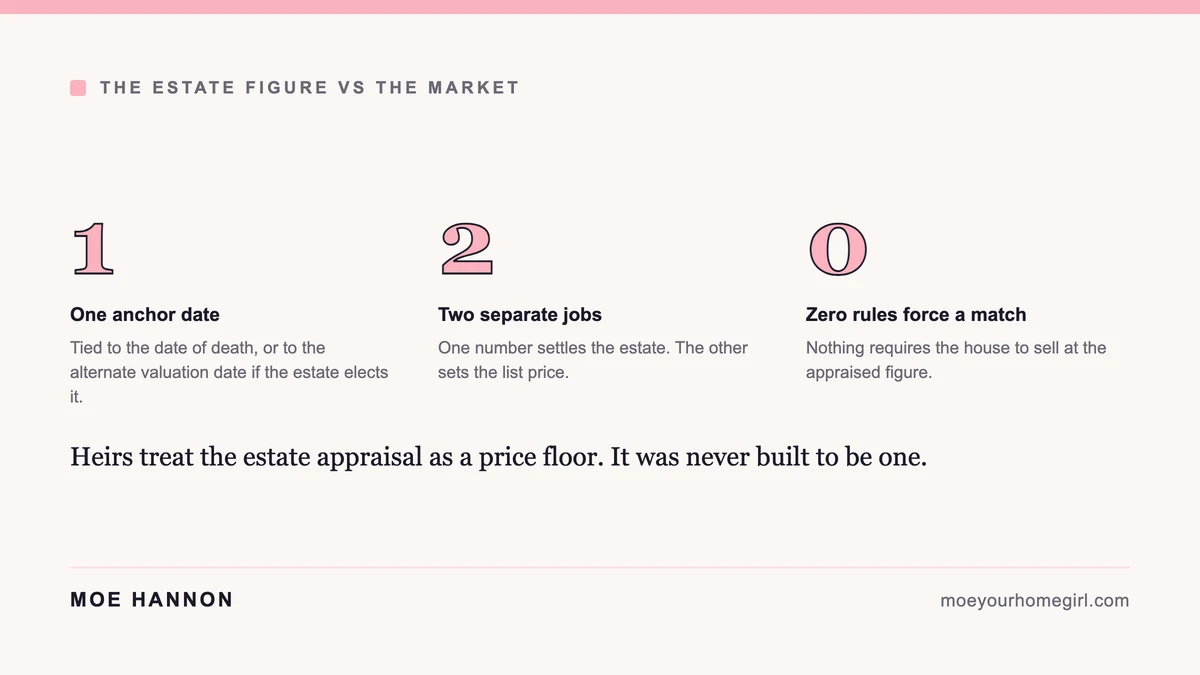
- It was never a price floor. Treating the appraisal as a minimum acceptable price is the single most common thing that stalls an estate listing.
- Put both numbers in front of everyone first. Side by side, in writing, to every beneficiary at once, before anyone says the words list price.
An estate sale usually arrives with a number already attached to it. Someone has had the house appraised as of the date of death, the figure is sitting in a file, and at least one heir has decided that is what the house is worth.
Then I run the market analysis and it comes back different. Sometimes higher, sometimes lower. That is the moment a family either relaxes or starts arguing, and which one it is depends almost entirely on whether anybody explained what the two numbers are for. Usually nobody has. I am a realtor, not an appraiser or an attorney or an accountant, so the tax and legal calls belong to the people the estate has hired. The house is the part I do.
Date of death appraisal vs market value: a house has two numbers, not one
A date-of-death appraisal is a retrospective valuation. The appraiser is asked to reconstruct what the property would have sold for on one specific day in the past, using the market as it stood on that day and the comparable sales that were available then.
A current market analysis asks something else entirely. What will a buyer pay for this house this month, in the condition it is in right now, against everything else for sale on these streets. Both are honest answers. They are answers to different questions, and nothing anywhere requires them to match.
Here is the split in one place:
| Date-of-death appraisal | Current market analysis | |
|---|---|---|
| Question it answers | What was this house worth on the day the owner died? | What will a buyer pay for it this month? |
| Who produces it | A licensed appraiser, working retrospectively | Your listing agent, from recent closed sales |
| Date it is anchored to | The date of death, unless the estate elects the alternate valuation date | Today, and it moves every season |
| What it is used for | The estate inventory and the heirs' cost basis | Setting the list price and reading offers |
| Who relies on it | The estate's attorney and accountant | You, the buyers, and their lender's appraiser |
What pulls the two numbers apart
- Time. Months usually pass between a death and a listing. Court steps, family decisions and clearing out a house all take what they take, and the market does not pause while they happen.
- Condition. An empty house changes. A roof nobody checked, a basement nobody visited, a furnace that ran all winter for no one. The retrospective appraisal describes a house that was still being lived in.
- The comparable sales. A retrospective appraisal works from sales that closed around the date of death. My analysis works from what closed in the last few months on the same streets.
- The market itself. Inventory in the DuPage towns I work moves season to season, and a house valued in one season lists into a different one.
What the estate figure is for, and who to ask about it
The date-of-death value does two jobs on the estate side. It goes into the inventory the estate files, and it sets the cost basis the heirs take the property at. The second one is why families care about it so much, because the basis is what a later sale gets measured against.
That is as far as I will take it, and I mean that. Basis, estate thresholds and what any particular family owes are questions for the estate's accountant and attorney working from the actual documents. The Illinois Probate Act of 1975 governs how estates are administered here, and the IRS publishes its own guidance on the basis of inherited property. Read them, then ask your own professional what they mean for you.
One wrinkle worth knowing before you treat that date as fixed: an estate is sometimes able to elect an alternate valuation date six months after the death, and where that election is made the value the heirs take follows it instead. Whether it is available, and whether it helps, is a question for the estate's accountant.
What I will say plainly is this. The estate figure was produced for the estate's paperwork. It was not produced to tell you what to list the house for.
How I build the list price instead
My side of it starts from closed sales, not from the appraisal in the file. I want sales in the same town, ideally on the same side of it, in the same build era, and closed recently enough that a buyer's own appraiser would reach for them too. Elmhurst, Glen Ellyn and Wheaton price differently from each other and differently within themselves, and a 1950s ranch three blocks from a Metra station is not the same asset as a 1990s colonial on the far edge of the same town.
Then I adjust for what the house is now. Deferred maintenance, dated systems, and whether the kitchen reads as liveable or as a project. That is the number I bring to the family, and I bring the estate appraisal in with it so both sit on the table at the same time. Sequencing that conversation properly is most of what I do as a probate and estate real estate agent in DuPage County.
Ask for that analysis in writing, and ask for the comparable sales to be attached to it. A number that arrives in a text message is not something you can hand to four beneficiaries. One that shows the closed sales behind it, what each house had and what was adjusted for, is a document that ends arguments instead of starting them. If a beneficiary lives out of state, that attachment is the only thing standing between you and a phone call every Sunday.
The buyer pool decides more than either number does
Estate homes usually draw two kinds of buyers. Owner-occupants who are willing to take on a renovation because they want the location, and investors who are pricing the work and want a discount for doing it. Which of those two is bidding is the biggest single factor in where the house lands, and neither of them has read the date-of-death appraisal.
That is worth saying out loud to the heirs early. The people who set the real price are strangers with their own lenders, and they will price the house they walk into. If the estate house has a tenant in it, that alone removes most of the owner-occupant pool, and the paperwork an occupied listing needs before it goes live is the next thing to work through.
Put both numbers in front of everyone before you talk price
The arguments tend to start the same way. One heir saw the estate appraisal months ago, nobody else did, and the list price arrives later as a surprise that looks like a loss. At that point the estate figure stops being a document and becomes a position.
So I do it the other way round. Both numbers, side by side, in writing, to every beneficiary at the same time, before anyone says the words list price. It costs an extra day and it removes most of the friction, because the conversation becomes what the market says rather than who is trying to sell Mom's house cheap.
If the deed turns out not to be in the form anyone expected, the sequence changes before the valuation does. The guide on selling a house held in a trust after death and the one on selling your parents' house after they pass away walk those two routes. DuPage estates that do need a court are filed at the courthouse in Wheaton, which is why estate work and Wheaton listings are so often the same conversation.
When the heirs still disagree
Sometimes they do, and the disagreement is rarely about real estate. When it happens I give everyone the same written analysis, offer to walk any beneficiary through the comparable sales on a call, and then step back, because the decision belongs to whoever holds authority under the will or the trust. The estate's attorney sorts out who that is. I do not referee families, and I do not pretend the appraisal settles it, because it does not.
I am a realtor, not an appraiser, an attorney or an accountant, and this is not legal or tax advice. What a specific estate owes, what basis a specific heir takes, and who holds authority to sign are all questions for the professionals the estate has hired. What I can tell you is what the market will do with the house, because that is the part a listing agent is there for.
Two numbers, two jobs. The date-of-death appraisal closes out what the house was worth on the worst day of your family's year. The market analysis opens the question of what somebody will pay for it now. Let the first one do its work on the estate's paperwork, and let the second one set the price.
Sources: Illinois Probate Act of 1975, 755 ILCS 5 · IRS Publication 551, Basis of Assets · IRS Topic no. 703, Basis of Assets. Statutes and guidance read 2026-09-16.
Holding an estate appraisal and no idea what to list for?
I do the house end of it in DuPage County. The market analysis in writing, the clear-out, the repairs worth doing, the listing and the closing. One update to every beneficiary at the same time, so nobody is chasing you for news.
Straight answers, no hedging.
Does the house have to sell for the date-of-death appraised value?
No. Nothing ties the sale price to the retrospective appraisal, and estate homes sell above and below that figure all the time. The appraisal records what the house was worth on one past date, for the estate's paperwork. What it sells for is set by the buyers who show up. If the difference between the two carries a tax consequence for the heirs, that is a question for the estate's accountant.
Why is the estate appraisal lower than what the neighbor's house just sold for?
Usually because the two figures are anchored to different dates and built from different comparable sales. A retrospective appraisal uses sales that closed around the date of death, so if months have passed it is describing an older market. Condition is the other half of it. A house that sat empty is not the house the appraiser valued, and the neighbor's place may well have been updated. Neither number is wrong.
Who orders the date-of-death appraisal?
The executor or trustee normally orders it, often on the advice of the estate's attorney or accountant, and a licensed appraiser produces it working retrospectively. It is worth getting early, while the house is still furnished and its condition on the date of death is easier to establish. A listing agent's market analysis is separate work and does not replace it.
What happens if the heirs cannot agree on a list price?
Whoever holds authority under the will or the trust makes the call, and the estate's attorney confirms who that is. What helps in practice is giving every beneficiary the same written analysis at the same time, and offering to walk anyone through the comparable sales directly. Most of the disagreements I see come from people working off different information rather than from a real dispute about value.
About the agent
I'm Maureen - but everyone calls me Moe. I have been selling real estate since 2019 and I work out of the Ellyn & Main team at KW Premiere Properties, 100 N Addison Ave in Elmhurst. I hold the Seller Representative Specialist and C2EX designations along with a Luxury Homes certification, and I am a member of KW Luxury. At least $250 of every commission check goes to ShowerUp Chicago and the YMCA of Elmhurst, where I sit on the board. If you are sorting out a house after a death, call me at 630-890-5430.
This is a realtor's guide, not legal, tax or appraisal advice.