Security Deposit Transfer When a Rental Property Sells: What Happens on Closing Day
You are a landlord selling a rental house with a tenant in it. The tenant paid a security deposit, and now you have to decide who holds it, how it moves and what you keep on file. Here is how the deposit travels from contract to closing day, and what Illinois law says about the clocks.
By Moe Hannon, Realtor · Ellyn & Main at KW Premiere Properties, Elmhurst IL · Updated October 2026
- The new owner takes over the deposit. For a private landlord's sale, Illinois Legal Aid Online says the new owner becomes responsible for any security deposits given to the old landlord.
- You can stay on the hook anyway. The same page says a tenant can sue the former owner or the current owner, though the tenant can recover the deposit only once.
- The state return clocks run from move-out, not from closing. Under the Security Deposit Return Act, a landlord who wants to withhold for damage must send an itemized statement within 30 days of move-out, and without one the deposit is due back in full within 45 days.
- The interest law is for large buildings. The Security Deposit Interest Act applies to a lessor of 25 or more units, so it does not reach a typical single-family rental.
- Settle the deposit in the sale contract and show it on the closing statement. Your attorney decides whether it moves as a credit or as funds.
The security deposit is the tenant's money, and it is sitting in your account or your records when the house goes under contract. Security deposit transfer when a rental property sells is a closing-day task that can get missed when nobody owns it. A buyer can assume the title company will handle it, and a title company can assume the contract covers it. The contract covers it only if you wrote it in.
This post follows the deposit from the day you sign the sale contract to the day the tenant eventually moves out. For the paperwork a tenant-occupied listing needs before it goes live, read documents needed to sell a tenant-occupied property. I am a real estate agent, not an attorney, and your lease and your attorney decide the details.
How does a security deposit transfer work when a rental house sells?
The buyer, once the sale closes and the deposit has changed hands. Illinois Legal Aid Online lists what happens when a private landlord sells while a tenant lives there. The new owner takes over as landlord, and its page says "the new owner becomes responsible for any security deposits provided to the old landlord." The same page says the new owner must give the tenant their contact information and that rent is paid to the new owner from then on. It is Illinois Legal Aid Online, Ending a lease, and it names no deadline for that contact notice.
Now the part that matters to you as the seller. The same page says that if a deposit is not returned on time, "the tenant can sue either landlord or both," and that the tenant can recover the deposit from only one of them. So the old owner is not automatically out of the picture on closing day. You lower your exposure when the deposit has moved, the buyer has acknowledged it in writing and the tenant has been told who the landlord is.
That is why I treat the deposit as a line item in the sale, not an afterthought. It should be stated in the contract, listed on the closing statement and backed by a copy of the lease and the amount you received.
What does Illinois law say about the clock?
The main statute is the Security Deposit Return Act. Section 1, as I read it on the Illinois General Assembly site (text current through Public Act 103-224, effective January 1, 2024), says a lessor may not withhold any part of a deposit as reimbursement for property damage unless the lessor, within 30 days of the date the lessee vacated, or within 30 days of the date the lessee's right of possession ends, whichever is later, gives the lessee an itemized statement of the damage and its cost, with receipts attached. If no statement is furnished, the lessor must return the deposit in full within 45 days of the date the lessee vacated. A court that finds a lessor refused to give the statement, or gave it in bad faith, and failed to return the deposit, can award twice the deposit plus costs and attorney's fees. Read the section yourself at 765 ILCS 710/1.
Look at what starts those clocks: the tenant leaving. A sale closing does not start them in the sections I read. If the tenant moves out three weeks after closing, the clocks run against whoever is the landlord on the day the tenant leaves, and the contract should say who handles the move-out inspection and the itemized statement.
The interest law is separate. 765 ILCS 715/1 applies to a lessor of residential property with 25 or more units in one building or a complex on contiguous parcels, for deposits held more than six months. A single-family rental generally falls outside it, so check your lease for any interest term. Your attorney confirms how both acts apply to your property.
The closing-day sequence for a tenant's security deposit
| Stage | What happens | Your job as the seller | Proof to keep |
|---|---|---|---|
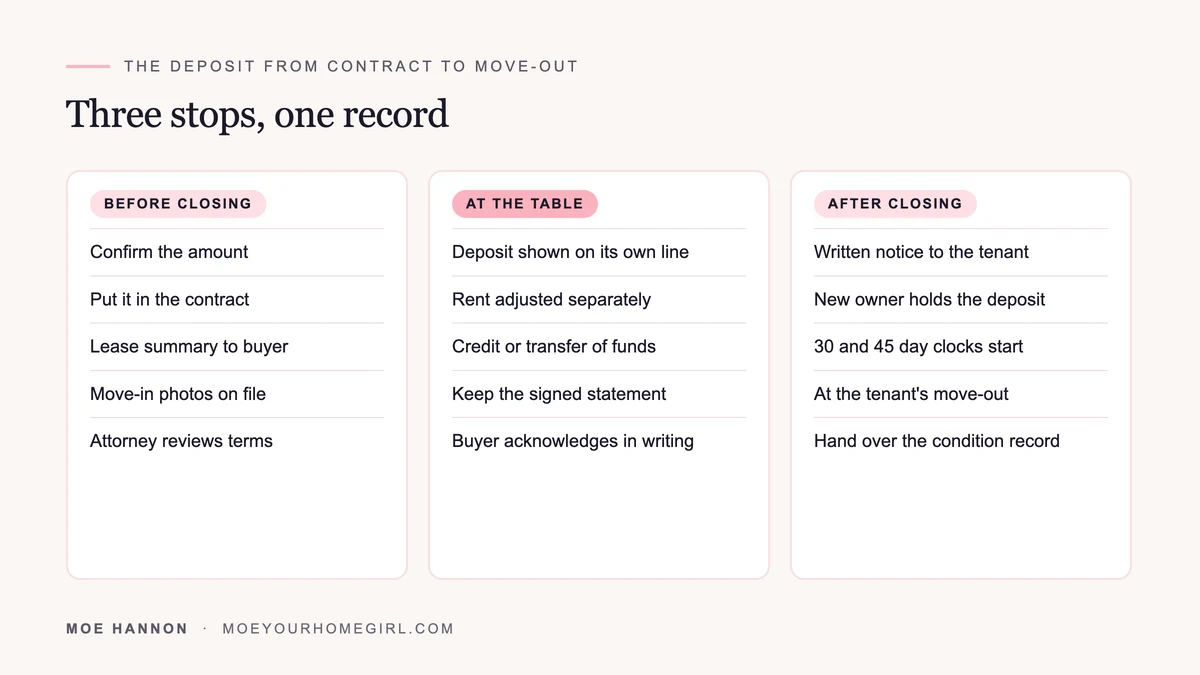
| Before closing | The sale contract states how the deposit moves. The buyer's side asks for the lease. | Confirm the deposit amount against your records and add it to the lease summary | Lease, receipt for the deposit, bank record of where it is held |
| At the table | The closing agent handles the deposit as a credit or as funds, as the contract says | Check the closing statement shows the deposit and any rent adjustment | Signed closing statement and the contract page that covers the deposit |
| Right after closing | The tenant learns who the new landlord is and where rent goes | Send a written notice with the buyer's contact details, as your attorney advises | Copy of the notice and the date it was delivered |
| When the tenant moves out | The return clocks in the Security Deposit Return Act start | Hand over the move-in condition record so the new owner can answer a damage claim | Move-in checklist, photos and any prior repair receipts |
The table shows who does what and when. The contract and the closing statement set the actual mechanics, and your attorney decides how the deposit moves.
What should you hand the buyer's side before closing?
The buyer inherits the lease, so give them what a landlord would need on day one. Think of it as a short folder.
Start with the signed lease and any addenda. Add the amount of the security deposit and the date you received it. Add the current rent, the rent due date and a record of the last payment. Include the move-in condition checklist and photos if you have them, since those are the only evidence the new owner will have if the tenant leaves and a damage question comes up. Finish with the tenant's contact details and a note on any open repair request.
If the deposit sits in a separate account, bring the statement that shows the balance, and make sure the amount matches the amount in the lease. A mismatch between the lease and your bank record is the kind of small difference that turns into a long email chain between two attorneys. Fix it before the buyer's side finds it, and write the corrected figure on the lease summary.
This folder also helps the sale. A buyer's attorney who sees the deposit documented at the contract stage has one less question for yours. If the buyer is an investor, the folder is also the income statement for the property, and the tenant and buyer pool post explains why that matters to your price.
How do rent and the deposit show up on the closing statement?
Two money items belong to the tenancy, and they are different. The deposit is held for the tenant and moves to the new owner. Rent for the month of closing is income, and your contract states how it is divided between seller and buyer. The closing agent will ask you for the rent roll or the lease to calculate it.
Do not blend the two on paper. A deposit credit and a rent adjustment are separate lines, and a tenant who later asks about the deposit should find a clean record of where it went. Ask the closing agent to show each as its own line, and keep a copy of the statement with your lease file.
If you own in Elmhurst or Wheaton, the same folder and the same two lines apply. The process does not change from town to town, and what to do about the tenant's showings is covered in selling a house with tenants in DuPage County.
What if the tenant moves out right around closing?
The dates need to be spelled out. The Return Act's clocks are counted from the date the tenant vacates, so who is the landlord on that day matters, and your attorney tells you how the Act applies to your sale. Either way, decide in the contract who walks the unit with the tenant, who sends any itemized statement and who holds the deposit until then.
If the move-out date is close to the closing date, ask your attorney to put a line in the contract that names the person responsible. A line costs nothing and avoids an argument with a tenant after the sale.
I am a real estate agent, not an attorney. How a deposit moves in your sale, and how the Illinois statutes apply to your lease, are questions for your landlord's attorney. What I can do is build the folder and the closing-day sequence so your attorney can answer quickly.
So, how does a security deposit transfer when a rental property sells? It moves to the new owner, it appears on the closing statement as its own line, and the tenant gets a written notice. Put it in the contract, keep the proof and remember the state clocks start when the tenant leaves, not when you close.
Sources: 765 ILCS 710/1, Security Deposit Return Act, Statement of damage · 765 ILCS 715/1, Security Deposit Interest Act · Illinois Legal Aid Online, Ending a lease (FAQ). Opened and read on 2026-10-28.
Selling a rental house with a tenant in it?
Send me the address and the lease end date. I will tell you what the buyer's side will ask for, how the deposit should show up in the contract and what to ask your attorney before you list.
Straight answers, no hedging.
Who holds the security deposit at closing?
The new owner becomes responsible for it, according to Illinois Legal Aid Online. How it gets there is set by your sale contract and the closing statement, as a credit to the buyer or as a transfer of funds. Your attorney picks the method and confirms it is written down.
Does interest on the deposit transfer with it?
It depends on the building. The Security Deposit Interest Act applies to a lessor of 25 or more units, so a single-family rental generally falls outside it. If your lease promises interest, that promise travels with the lease, and your attorney should confirm how to treat it at closing.
How soon must the tenant be told about the new owner?
Illinois Legal Aid Online says the new owner must give the tenant contact information and names no deadline. I did not find a deposit-notice deadline in the sections of the Security Deposit Return Act I read. A written notice right after closing is a sound habit, and your attorney can tell you whether your lease sets a date.
Is the seller still liable after closing?
It can happen. Illinois Legal Aid Online says a tenant who does not get a deposit back on time can sue the former landlord, the current landlord or both, and can recover the deposit only once. That is why a written acknowledgement from the buyer and a clean closing statement lower your exposure.
About the agent
I'm Maureen - but everyone calls me Moe. I have been selling real estate since 2019 and I work out of the Ellyn & Main team at KW Premiere Properties, 100 N Addison Ave in Elmhurst. I hold the Seller Representative Specialist and C2EX designations along with a Luxury Homes certification, and I am a member of KW Luxury. At least $250 of every commission check goes to ShowerUp Chicago and the YMCA of Elmhurst, where I sit on the board. If you are selling a rental house and want the deposit and the paperwork handled cleanly, call me at 630-890-5430.
This is a realtor's guide, not legal advice.