Sell First or Buy First? How to Line Up the Two Closings on a Move to a Condo
You are selling the house and buying the condo, and the two closings have to fit together. Sell first or buy first is really a question about which risk you want to carry. Here are the five ways owners line the closings up, what each one protects, and what each one asks of you.
By Moe Hannon, Realtor · Ellyn & Main at KW Premiere Properties, Elmhurst IL · Updated October 2026

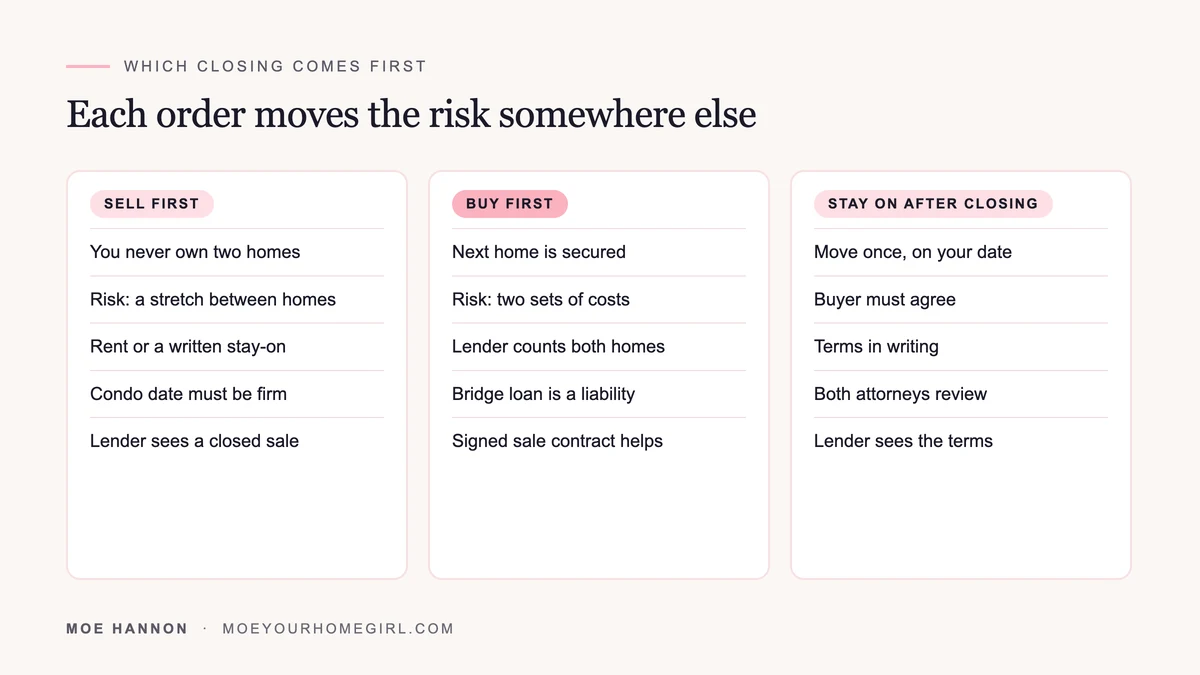
- Sell first or buy first is a choice of risk. Sell first risks having nowhere to live for a stretch. Buy first risks paying for two homes at once.
- There are five working ways to order the two closings: sell and rent, buy first and carry both, a sale-contingent offer, a bridge loan, or staying in the old house after closing under a written agreement.
- A bridge loan counts against you at the lender. Fannie Mae's guide treats it as a contingent liability in the debt-to-income ratio unless the sale contract is signed and its financing contingencies are cleared.
- The buy-side loan has its own clock. The lender must make sure you receive the Closing Disclosure at least three business days before closing, which sets the earliest day the condo can close.
- Talk to your lender and your attorney before you list. The order you pick decides what you ask each of them, so the order comes first.
Sell first or buy first? It is the first question many owners ask when moving from a house to a condo, and the honest answer is that each order moves the risk somewhere else. If you sell first, you may need a place to live between closings. If you buy first, you may pay for two homes until the first one sells. Neither is wrong. The right one is the one whose risk you can carry.
This post lays out the options, shows how the two closings fit together here in DuPage County, and gives you a sequence to follow. For what changes in the move itself, read moving from a house to a condo. I am a real estate agent, not a lender or an attorney, so I describe how each option works and tell you what to ask them. I leave out rates and loan terms on purpose.
Sell first or buy first: what are you really choosing?
You are choosing which of two problems you would rather solve. The first problem is time without a home. If the house closes before the condo does, there is a stretch between closing dates that you have to fill with a rental, a family member's spare room, or an agreement to stay put. The second problem is overlap. If the condo closes first, you own both homes for a while and carry the costs of both: the loan, the taxes, the utilities and the upkeep on a house you are trying to show.
A third factor sits under both. Your next home may not wait. A condo you want can sell to someone else while you wait to sell your house, and a house that sits empty while you chase the condo loses its best showing weeks. The order you pick should come from how firm your move date is and how much overlap you can carry, not from a rule of thumb.
Write down two numbers before you decide anything: the longest you could comfortably carry both homes, and the longest you could comfortably be between homes. If one of those is zero, your choice is already narrowed.
What does a lender look at when you own two homes for a while?
If you plan to buy first, your lender will ask what happens to the house. Fannie Mae's Selling Guide has a short section on bridge, or swing, loans. It says the funds from such a loan can be used to close on a new principal residence before the current one is sold, that this "creates a contingent liability" counted in the borrower's debt-to-income ratio, and that Fannie Mae will waive that requirement if the file has "a fully executed sales contract for the current residence, and confirmation that any financing contingencies have been cleared." That is in Selling Guide B3-6-05, Monthly Debt Obligations, and it governs loans your lender sells to Fannie Mae, so your lender confirms what applies to yours.
The federal rules name the same product. The CFPB's text of Regulation Z section 1026.43 uses a bridge loan of 12 months or less, such as a loan to finance the purchase of a new dwelling while the consumer plans to sell a current one within 12 months, as an example of a loan exempt from the ability-to-repay rules. That tells you a bridge loan is a recognized short-term product. It does not tell you what any lender will approve. The signed-contract point above is Fannie Mae's rule, and a listing with no contract does not meet it.
That is the reason the order matters for qualifying. Ask your lender one question before you make an offer on the condo: what do you need to see on my current house, and when, to approve this purchase?
The five ways to line up the two closings
| Option | What it protects | What it risks | What the other side will ask |
|---|---|---|---|
| Sell first and rent | You never own two homes. Your house sells at its own pace. | A move into a rental and a second move after. Rental availability on your dates. | The condo seller will want a firm closing date and proof of your financing. |
| Buy first and carry both | Your next home is secured. You show the house on your own schedule. | Two sets of costs until the house sells. A lender may count both homes. | Your lender will ask how both homes fit in your debt-to-income ratio. |
| Sale-contingent offer on the condo | You do not buy until your house is under contract or sold. | The condo seller may pick a cleaner offer. A contingency can weaken yours. | The condo seller will ask how firm your house sale is and for a deadline. |
| Bridge financing | You can close on the condo before the house sells. | An extra loan and its costs. The lender counts it unless the house is under signed contract. | Your lender will ask for the listing, the sale contract and the payoff plan. |
| Stay in the old house after closing | You move once, on a date you set, with no rental in between. | The buyer must agree. A written agreement has to cover the days you stay. | The buyer, their lender and both attorneys will ask for the terms in writing. |
No row is the right answer for everyone. The table shows what each order asks of you and of the other side, so the conversation with your lender and your attorney starts in the right place.
How do the two closings get lined up in Illinois?
Start with the contracts. Check each contract for an attorney review period after acceptance, counted in business days, with the length stated in the contract. If both contracts have one, the two windows will not start on the same day. Ask your attorney to review both with the plan in front of them, so a date in one contract does not break a date in the other.
Next is the buy-side loan. Under Regulation Z, section 1026.19(f), the lender has to see that you receive the Closing Disclosure no later than three business days before closing. If the condo closing is Thursday, the CFPB's own example has those papers reaching you by Monday, with each weekday counting as a business day. That sets the earliest day the condo can close, so work back from it when you plan the house closing. Ask your lender what else can restart the three-day wait, since the rule calls for new disclosures when certain loan terms change.
Then there are two title companies, or one doing both files. They handle the money, the payoffs and the deed for each closing, and they can tell you when funds from the sale are available. Whether the two closings can fall on the same day depends on those title companies and your lenders, so ask them early and ask for the answer in writing.
Last, check the condo side for anything that adds time. Condo documents and any association step belong in the buy-side timeline. The condo reserve study post covers what to read before you write the offer, and reading it first keeps surprises out of your schedule.
What does a week-by-week timeline look like from listing to the second closing?
The lengths below are a sample and not a promise. Your contracts and your lenders set the real ones.
Before week one, meet with your lender and your attorney. Pick the order you can carry, and ask each of them what they need to see. Weeks one through three are for the house: the repairs you decided on, photos, and the list date. If you plan to buy first, this is also when you shop for the condo, with the lender's answer already in hand.
Once the house is under contract, the attorney review window on that contract opens if your contract has one, along with the inspection. Your lender will want the signed contract in the file if you are using bridge financing or counting on the sale to qualify. If you are writing a sale-contingent offer on the condo, this is the moment its deadline starts to matter.
In the weeks that follow, both loans move through underwriting and the title work gets done. The three-business-day Closing Disclosure rule sets the earliest day for the condo closing, so work back from the condo date. If you are staying in the old house after closing, the written agreement is signed before the sale closes, and the move-out day is on the calendar. After the second closing, change your address, set up the new utilities and hand over the keys.
What should you do this week?
Four steps get you moving without committing to an order too soon.
First, call your lender and ask the one question from above: what do you need to see on my current house, and when? Second, call your attorney and ask them to read both contracts together once you have an offer on either side. Third, decide your two numbers, the longest you can carry both homes and the longest you can be between homes. Fourth, talk to me about the listing date, since the house is the one piece of the plan you control directly.
If you own in Glen Ellyn or Elmhurst, I can walk through the sale side with you before you touch the condo search. The decision is easier once the sale side has a date.
I am a real estate agent, not a lender or an attorney. Whether you qualify while owning two homes is a question for your lender. How the contracts and closings fit together legally is a question for your attorney. I can lay out the sale side so each of them can answer quickly.
So, sell first or buy first? Pick the order whose risk you can carry, ask your lender what they need to see on the current house, have your attorney read both contracts together, and work back from the condo closing date. Everything else in the plan follows from that order.
Planning a move from a house to a condo?
Send me the address and the date you would like to be in the condo. I will lay out which order fits, what to ask your lender and attorney, and where the house sale fits in the calendar.
Straight answers, no hedging.
Can I buy a condo before my house sells?
Yes, and some owners do. Your lender decides whether you qualify while owning both, and may count the costs of both homes. A bridge loan is one way to do it, and Fannie Mae's guide treats it as a liability unless the sale contract is signed and its financing contingencies are cleared. Ask your lender what they need to see before you make the offer.
What is a sale contingency?
It is a term in your offer on the condo that makes the purchase depend on your house selling or going under contract by a deadline. It protects you from owning both homes. It can make your offer less attractive to the condo seller, who may prefer an offer with no condition. Your attorney helps you write the deadline.
Can I stay in my house after the sale closes?
Only if the buyer agrees and the terms are in writing. The agreement covers how many days you stay, what you pay for use of the house, who is responsible for damage and what happens if you stay past the date. The buyer's lender and both attorneys will want to see it before closing. Ask your attorney to draft or review it.
How do two closings on the same day work?
The title companies and lenders on each side decide whether it can be done and in what order. The sale has to close and the money has to be available before it can be used on the purchase, and the lender's Closing Disclosure for the condo has to reach you three business days before closing. Ask both title companies early whether a same-day plan works for your files.
About the agent
I'm Maureen - but everyone calls me Moe. I have been selling real estate since 2019 and I work out of the Ellyn & Main team at KW Premiere Properties, 100 N Addison Ave in Elmhurst. I hold the Seller Representative Specialist and C2EX designations along with a Luxury Homes certification, and I am a member of KW Luxury. At least $250 of every commission check goes to ShowerUp Chicago and the YMCA of Elmhurst, where I sit on the board. If you are selling a house and buying a condo and want the two closings to line up, call me at 630-890-5430.
This is a realtor's guide, not legal advice.