Which DuPage Metra Station Has the Fastest Commute to Chicago? The Math Nobody Runs Before They Buy
Every DuPage town says it is a short train ride from the Loop. The schedule says something more specific. Here are the scheduled minutes from ten stations, why the order of the stops matters more than the miles, and how to turn the numbers into a short list of streets.
By Moe Hannon, Realtor · Ellyn & Main at KW Premiere Properties, Elmhurst IL · Updated September 2026
- The closest station is not always the fastest. What decides the ride is how many stops the train makes before downtown, and that changes train by train.
- Elmhurst has the shortest scheduled ride on the Union Pacific West line. Its fastest weekday morning train is 27 minutes to Ogilvie and its typical midday train is 40. Wheaton runs 43 to 59.
- On the BNSF line, the fast trains are the story. Downers Grove Main Street has a 30 minute morning train and a 60 minute one. Which train you can catch matters more than which station you pick.
- Express versus all-stop is worth 16 minutes on the Union Pacific West line and 30 or more on BNSF. A Glen Ellyn express beats an Elmhurst all-stop, but only one morning train does it.
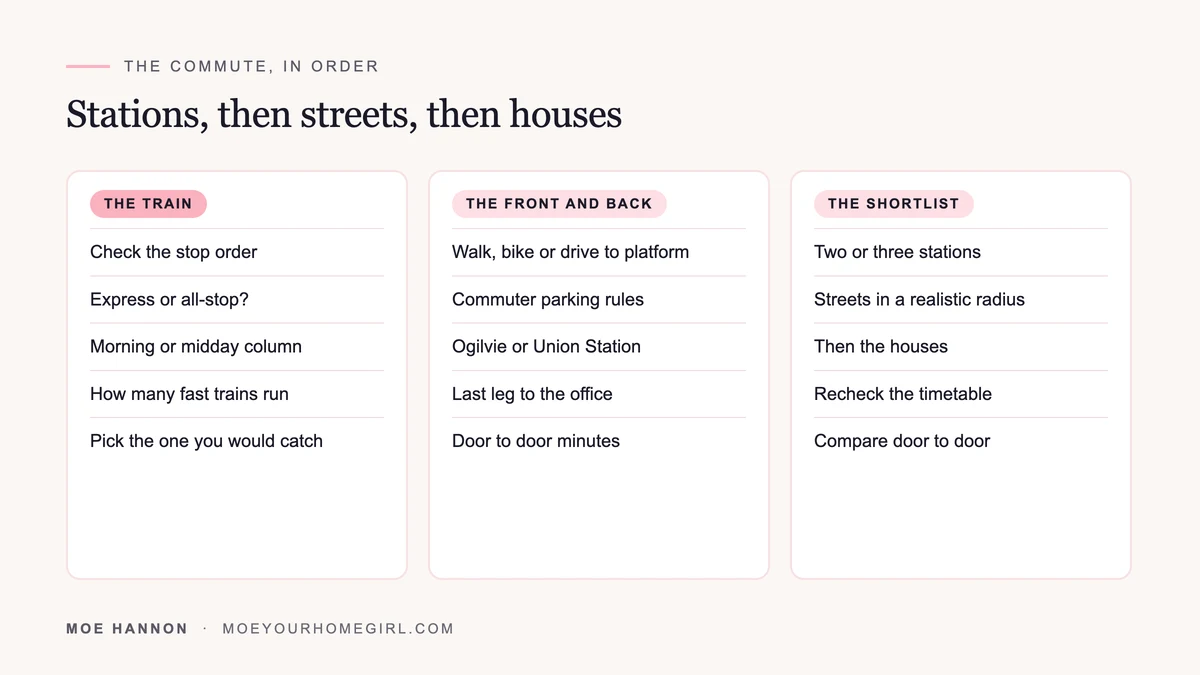
- Decide in this order: shortlist stations by the trains you would really take, then streets within a realistic walk or drive, then houses.
Which DuPage Metra station has the fastest commute to Chicago is the first question many relocating buyers ask, and the honest answer is that it depends on the train, not just the station. A town sitting on the same line as another can have a quicker ride, a slower ride or both, depending on where it falls in the stop order and which trains stop there.
The numbers below come from Metra's own published schedule data, downloaded on October 14, 2026. They are scheduled running times for weekday trains toward downtown, not the walk to the platform, the wait, the drive or the parking. Timetables change, so treat this as a way of thinking and check the current timetable before you decide. The table covers ten stations on the Union Pacific West and BNSF lines, not every DuPage station; it leaves out the Milwaukee District West line and some BNSF stops.
Stop order beats distance
Two lines serve the stations in this post. The Union Pacific West line runs from the suburbs into Ogilvie Transportation Center, and the BNSF line runs into Chicago Union Station. On both, a train picks up riders at its stops in a fixed order, and an express train skips some of the stops between you and the city.
That is why distance is a poor guide. Take the Union Pacific West line. A midday all-stop train leaving Glen Ellyn calls at Lombard, Villa Park, Elmhurst, Berkeley, Bellwood, Melrose Park, Maywood, River Forest, Oak Park and Kedzie before it reaches Ogilvie. The fastest weekday morning train from Glen Ellyn calls only at Elmhurst. Same platform, same line, same tracks, 53 minutes against 37.
So a station farther out on an express pattern can beat a station closer in on an all-stop pattern. The Glen Ellyn express, at 37 minutes, is faster than the all-stop train from Elmhurst, at 40. The catch is how many of those trains there are, and the table shows that too.
Express versus all-stop, and how to read a timetable for the train you would take
Do not read a timetable for the fastest train on the page. Read it for the trains you would take. Find the arrival you need downtown, work back to the departure from your station, and look at how many stops that train makes. If it is the one express a day and you cannot reliably make it, the number you should be using is the all-stop one.
The counts show how much this varies. Of the Elmhurst trains leaving between 6:00 and 9:00 in the morning, 7 of 12 run within three minutes of the station's fastest time. At Glen Ellyn it is 1 of 11, and at Wheaton 1 of 10. A buyer who works fixed hours can plan around a single express. A buyer with a changing schedule is mostly riding the slower pattern, and the slower pattern is what the second column of the table is for.
Scheduled weekday minutes to downtown from ten DuPage stations
| Station | Line, to | Morning trains (leaving 6:00 to 9:00 am), minutes | Stops before downtown on the fastest morning train | Midday trains (9:00 am to 3:00 pm), minutes | Weekday trains toward downtown |
|---|---|---|---|---|---|
| Elmhurst | Union Pacific West, to Ogilvie | 27 to 40 | 0 | 40 | 29 |
| Villa Park | Union Pacific West, to Ogilvie | 34 to 45 | 2 | 45 | 27 |
| Lombard | Union Pacific West, to Ogilvie | 38 to 49 | 3 | 49 | 27 |
| Glen Ellyn | Union Pacific West, to Ogilvie | 37 to 53 | 1 | 53 | 29 |
| College Avenue | Union Pacific West, to Ogilvie | 40 to 56 | 2 | 56 | 28 |
| Wheaton | Union Pacific West, to Ogilvie | 43 to 59 | 3 | 59 | 28 |
| Hinsdale | BNSF, to Union Station | 34 to 48 | 5 | 41 | 30 |
| Westmont | BNSF, to Union Station | 42 to 56 | 8 | 47 | 33 |
| Downers Grove Main Street | BNSF, to Union Station | 30 to 60 | 0 | 30 or 52 | 33 |
| Naperville | BNSF, to Union Station | 39 to 71 | 0 | 64 | 32 |
Source: Metra published schedule data (the GTFS file), downloaded 2026-10-14. The weekday service in that file is the same from October 12 through December 31, 2026. Minutes are scheduled running time from the station departure to the downtown terminal, rounded to the minute. They leave out the wait, the walk, the drive, parking and the trip from the terminal to the final destination.
Which DuPage Metra station has the fastest commute to Chicago, and what does the table leave out?
On the Union Pacific West line, Elmhurst is both the closest of these stations and the quickest, and the pattern is steady: seven of its twelve morning trains are near its best time. The ride lengthens as you go west, from 27 to 40 at Elmhurst to 43 to 59 at Wheaton, and Glen Ellyn sits in between with an unusual spread, because one express changes its range.
On the BNSF line, the spread inside a single station is bigger than the spread between stations. Downers Grove Main Street has a 30 minute train and a 60 minute train in the same morning window, and Naperville runs from 39 to 71. At those stations the question is not how far you are from the city. It is which train you will be on.
What the numbers do not say is which town is a better place to live. They describe a schedule. A ten-minute difference in a train ride can be worth a great deal to one buyer and nothing to another, and it is only one input next to the school district boundaries, the house, the street and the budget.
The part of the commute the timetable leaves out
The scheduled minutes are the middle of the trip. Add the front and the back. At the front is how you reach the platform: a walk, a drive, a drop-off, and parking if you drive. Commuter parking is handled by each village or by Metra, and the rules and availability differ, so ask about it before you rely on it. At the back is the trip from Ogilvie or Union Station to wherever you actually work, which can add real minutes on either end.
Peak and off-peak matter too. In this data, the Union Pacific West midday trains all run the all-stop pattern, so a midday trip from Wheaton is the 59 minute ride, not the 43. If you work a schedule that sends you in after the morning peak or home before the evening one, use the midday column.
Put it together as door to door, for the train you would take, on the days you would take it. That is the real commute, and it is the one number worth comparing between towns.
How do you go from stations to streets to houses?
Once you have a shortlist of stations, the next filter is the street. Pick a realistic distance from the platform for how you will get there, walking, biking or driving, and look at the blocks inside it. Then the houses.
That order saves a lot of time. Buyers who start with houses fall for a kitchen and then discover the ride is longer than they planned. If you are still choosing among towns, the pages on Elmhurst, Glen Ellyn and Wheaton describe the housing and the downtowns around each station, and the page on relocating to DuPage County with a local real estate agent explains how I help out-of-area buyers sequence the search.
Worth saying plainly. Metra changes its timetables, and the numbers here are a snapshot. Before you make a decision that depends on a train, check the current weekday timetable for the line and the time you would travel. This post describes schedules, not the places or the people around each station.
So, which DuPage Metra station has the fastest commute to Chicago? On the Union Pacific West line, Elmhurst has the shortest scheduled ride. On the BNSF line, the answer changes with the train. Shortlist stations by the trains you would really catch, then streets, then houses, and the commute stops being a guess.
Sources: Metra, published schedule data (GTFS file), downloaded and read on 2026-10-14. Station order and running times are computed from the weekday trips toward the downtown terminal.
Relocating to DuPage County and weighing the train?
Tell me where you work and what hours you keep. I will help you build a short list of stations and streets before you look at a single house.
Straight answers, no hedging.
Is the fastest station always the closest one to Chicago?
No. A train's stop order and whether it runs express matter more than raw distance. In the schedule data, the fastest Glen Ellyn morning train, at 37 minutes, is quicker than Elmhurst's all-stop train at 40, although Elmhurst is closer to the city.
What is the difference between express and all-stop?
An all-stop train calls at every station on the line. An express skips some of them. On the Union Pacific West line, the same Glen Ellyn platform has an all-stop ride of 53 minutes and an express ride of 37. The timetable shows which trains stop where.
How long is the commute at peak versus off-peak?
It depends on the line. On the Union Pacific West line, midday trains in this data run the all-stop pattern, so midday rides are the longer numbers in the table. On the BNSF line, midday rides vary by station, and some stations keep a faster pattern at midday.
Does parking change the real commute?
It can. Parking adds the time to find a space and walk to the platform, and the rules and availability differ between villages and stations. Ask the village or Metra how commuter parking works at the station you are considering before you build a plan around driving to it.
About the agent
I'm Maureen - but everyone calls me Moe. I have been selling real estate since 2019 and I work out of the Ellyn & Main team at KW Premiere Properties, 100 N Addison Ave in Elmhurst. I hold the Seller Representative Specialist and C2EX designations along with a Luxury Homes certification, and I am a member of KW Luxury. At least $250 of every commission check goes to ShowerUp Chicago and the YMCA of Elmhurst, where I sit on the board. If you are moving into DuPage County and want somebody to help you narrow stations, streets and houses, call me at 630-890-5430.
This is a realtor's guide, not legal advice.