Condo Reserve Study Before Buying: What to Read Before You Write the Offer
You found the unit. The kitchen works, the light is good, and the monthly assessment looks fine. What decides whether it stays fine is in a stack of association paperwork most buyers skim. Here is what to read first, in what order, and what each page can tell you.
By Moe Hannon, Realtor · Ellyn & Main at KW Premiere Properties, Elmhurst IL · Updated September 2026
- You are buying a share of a building, not just a unit. The roof, the elevator, the parking structure and the brick belong to everyone, and the association's money is what keeps them up.
- Illinois has the seller make nine items available for your inspection on demand. Section 22.1 of the Condominium Property Act lists them, including the reserve fund, anticipated capital expenditures, pending suits and the building's insurance.
- The reserve study itself sits under a different section. Section 19 lists any reserve study, seven years of minutes and the books among the records the association keeps. Ask for them through the seller.
- Read the minutes for work that is discussed before it is assessed. Roof, tuckpointing, elevator and garage repairs show up in meetings long before they show up as a bill.
- Put the request in writing and bring your attorney in early. The documents are due within 10 business days of a written request, so the request should go out the day you are under contract.
A condo reserve study before buying is the document a buyer should ask about first on any building, and it is often the one a buyer never sees. A reserve study is an independent look at the big shared parts of a building, what condition they are in, when each will need replacing and what that is expected to cost. The association's reserve fund is the savings account meant to pay for it. The question is whether the two match.
This post is about reading the paperwork, not about the lifestyle side of living in a condo, which is covered in moving from a house to a condo. It describes what the documents show. It is not legal advice, and your attorney should read the originals.
What Illinois makes the seller give you
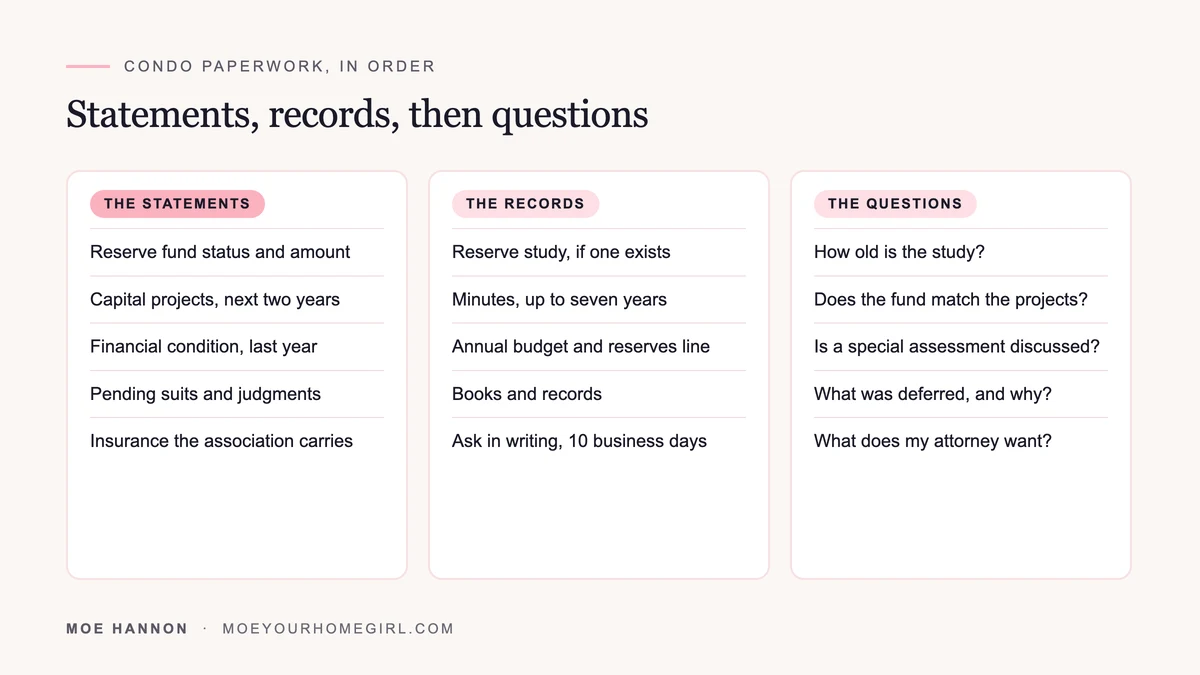
The starting point is section 22.1 of the Illinois Condominium Property Act. On a resale, the unit owner has to obtain from the board of managers, and make available to the buyer on demand, a short list of items. Read it as a checklist: the declaration, bylaws and rules; a statement of any liens and of the account of the unit; a statement of capital expenditures the association anticipates within the current or next two fiscal years; a statement of the status and amount of the reserve fund, including any part of it earmarked for a specific project; the association's statement of financial condition for the last fiscal year available; the status of any pending suits or judgments; what insurance the association provides for all owners; a statement about improvements the prior owner made; and who the principal officer is.
The association's officer is to furnish all of it within 10 business days of a written request. That is the part buyers miss. Nothing arrives on its own. Somebody has to ask, in writing, and the clock starts when they do.
A condo reserve study before buying is a separate document, and the seller asks for it
Notice what section 22.1 does not list: the reserve study itself and the meeting minutes. Those fall under section 19, which says what records an association must keep at its principal office. The list includes the minutes of association and board meetings for the preceding seven years, the current insurance policies, the books and records for the current and ten prior fiscal years, and "any reserve study." That wording matters. It reads as though a study may or may not exist, so the first question is simply whether there is one and how old it is. The annual budget is a separate piece. It comes under section 18, which has each owner receive the proposed budget at least 25 days before the board adopts it, with an indication of which portions are intended for reserves, capital expenditures or repairs.
The right to inspect those records belongs to members of the association, which means the seller, not you. So the practical route is a written request from the seller to the board, made during your attorney review period, and an honest answer from the seller if the board refuses or the study does not exist. Section 19 gives the board 10 business days to respond, and a missed deadline is treated as a denial. Read the full text of section 19 with your attorney before you rely on any of this.
The what-to-read-first table: each document and what it can mean for you
| Document | Where it comes from | What to look for | What it can mean for you |
|---|---|---|---|
| Reserve study | Section 19 record, requested through the seller | The date, who prepared it, each component, its remaining life and the funding plan it recommends | A study that is years old, or that no one has updated since a major repair, tells you less than it appears to |
| Statement of the reserve fund | Section 22.1, item 4 | The balance, and any part of it already earmarked for a project | A balance that is mostly spoken for leaves less than it looks like |
| Anticipated capital expenditures | Section 22.1, item 3 | Projects planned in the current or next two fiscal years, and how they are to be paid for | A named project with no matching reserve money points to a loan or a special assessment |
| Annual budget | The board; owners receive the proposed budget at least 25 days before adoption | The part set aside for reserves, capital expenditures and repairs, compared with last year | A reserve line that stays flat while costs rise is worth a question |
| Statement of financial condition | Section 22.1, item 5 | Income against expenses over the last year, and what was spent from reserves | A deficit covered by reserves is a pattern to understand |
| Meeting minutes, up to seven years | Section 19 record, requested through the seller | Roof, masonry, elevator, garage and plumbing discussions, bids, and any talk of an assessment | Work discussed three meetings in a row is work that is coming |
| Pending suits and judgments | Section 22.1, item 6 | Who is suing whom, and whether the association is exposed | A suit over defects in the building can touch every owner |
| Insurance statement | Section 22.1, item 7 | What the association's coverage includes for all owners | Tells you what you will need to cover on your own, which your insurance agent should confirm |
No single row settles anything. The point of the table is the order: reserves and projects first, then the budget and the year's results, then the minutes that explain both.
How do you read funded against underfunded reserves?
A reserve fund is funded or underfunded relative to what the building is expected to need, and only the study can tell you that. Start with the study's own summary, which should say what it considers the building to need set aside and what the association has set aside. A fund that is close to the study's figure is in good shape. A fund far below it is not a defect in the unit, but it means the gap gets closed one of three ways: higher monthly assessments, a loan the association takes on, or a special assessment.
Be careful with a rule of thumb. You will see a funding percentage presented online as the number to look for. That figure comes from a vendor's own tool, not from the Illinois statute or from any standard the law adopts, and a building at a lower percentage with a short list of cheap projects can be in better shape than one at a higher percentage facing an expensive one. Read the components. The percentage is a summary of them, not a substitute.
Special assessments are the reason this matters. The Act lets a board adopt a separate assessment for an emergency or an expense the law requires without a vote of the owners, and the amount lands on whoever owns the unit at the time. You want to know before you are that owner.
Read the minutes for what is discussed before it is assessed
The minutes are the early warning system. A roof is not replaced in one meeting. It appears as a leak complaint, then a request for bids, then a bid comparison, then a discussion of how to pay, then a vote. If you read back through a year or two of minutes, you can see where a building is in that sequence for each major component.
Look for the same handful of words: roof, tuckpointing, lintels, balconies, elevator, boiler, garage, sewer, windows. Look for bids and who received them. Look for the phrase "special assessment" or a discussion of a loan. And look for what the board decided not to do, because a repair deferred for a year is usually a bigger repair the next year.
If the minutes are thin, that is information too. A building that holds few meetings or keeps sparse minutes gives you less to read, and you should weigh the missing detail.
What should you do with what you find?
None of this is about finding a reason to say no. A building with a current study, a reserve fund that tracks it and a board that talks about repairs before they are urgent is a building you can plan around. The point is to know which kind you are in before the offer, not after the inspection.
So put the written request for the documents in on the day you go under contract, have your attorney review them within the review period, and ask your lender what it needs from the association. If the documents come back late, incomplete or not at all, that belongs in your attorney's hands while you still have options under the contract.
If you are weighing a condo against staying in a house, the condo and right-sizing move guidance for DuPage County lays out the decision from the house side. Either way, this is the kind of paperwork sorting I help buyers with in Elmhurst and Glen Ellyn: separating the paperwork into what matters and what is boilerplate before you commit.
Worth saying plainly. I am a real estate agent, not an attorney, an engineer or an accountant. A reserve study is a professional document and your attorney should read the originals. What I can do is tell you which pages to ask for, in what order, and which lines tend to matter.
So, a condo reserve study before buying: ask for it through the seller, read the date and the funding plan, check the reserve statement against the projects the association says are coming, and use the minutes to see where each big repair stands. The statements Illinois requires and the records the association keeps will not tell you everything, but together they tell you more than a showing ever will.
Once the building checks out, the next question is timing, and whether to sell first or buy first covers how to line up the closing on your current house with the condo.
Sources: 765 ILCS 605/22.1, resale disclosure · 765 ILCS 605/19, records of the association · 765 ILCS 605/18, budget and reserves provisions. Illinois General Assembly, opened and read on 2026-10-14. Section 22.1 is also scheduled to change on 2027-01-01 under Public Act 104-734, which adds the association's collection policy to the list.
Looking at a condo in DuPage County?
Send me the building and the unit. I will tell you which documents to request, what to read first and which questions to take to your attorney before you write a number down.
Straight answers, no hedging.
What is a condo reserve study?
It is an independent assessment of the shared parts of a building, such as the roof, the exterior walls, the elevator and the parking areas. It estimates each part's remaining life and replacement cost and recommends how much the association should set aside to cover them. Illinois lists "any reserve study" among the records an association keeps, so some buildings have one and some do not.
How do I get a reserve study before I make an offer?
Ask your agent to request it through the listing side, and ask your attorney to include a request in the contract. The right to inspect the records belongs to the seller as a member, so the route runs through the seller and a written request to the board, which has 10 business days to answer.
What does an underfunded reserve mean for me?
It means the building may need to raise more money later than the study planned for. That can show up as higher monthly assessments, an association loan or a special assessment. It is not automatically a reason to walk away, but it is a reason to read the projects list and price the risk before you commit.
Do meeting minutes really matter?
Yes. Large repairs are discussed for months before anyone is billed, and the minutes record the bids, the votes and the plan for paying. Illinois requires the association to keep seven years of them. Reading a year or two tells you what is coming and how the board handles it.
About the agent
I'm Maureen - but everyone calls me Moe. I have been selling real estate since 2019 and I work out of the Ellyn & Main team at KW Premiere Properties, 100 N Addison Ave in Elmhurst. I hold the Seller Representative Specialist and C2EX designations along with a Luxury Homes certification, and I am a member of KW Luxury. At least $250 of every commission check goes to ShowerUp Chicago and the YMCA of Elmhurst, where I sit on the board. If you are weighing a condo and want somebody to help you sort the association paperwork before you write an offer, call me at 630-890-5430.
This is a realtor's guide, not legal advice.